Delmonico's Restaurant
26th St & 5th Ave (Madison Square location)
America's First Fine Restaurant
Before Delmonico's, dining out in America meant a tavern ordinary — a long table, a fixed hour, whatever the innkeeper chose to serve. That changed in 1827 when Swiss-Ticinese brothers Giovanni (John) and Pietro (Peter) Delmonico opened a small pastry shop and cafe at 23 William Street in lower Manhattan. Born near Lake Maggiore and trained in the European confectionery trade, the brothers brought with them an entirely new idea: that a restaurant could be a destination in itself, a place of refinement rather than mere sustenance.
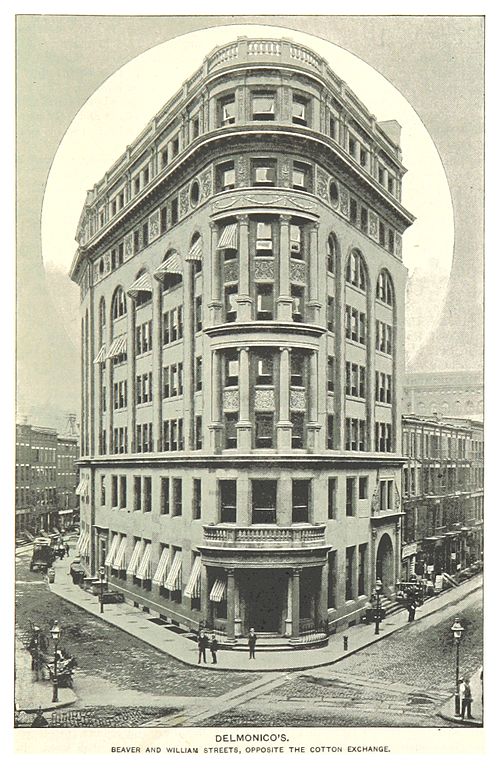
By 1831 they had expanded into a full restaurant, and in doing so introduced innovations Americans had never seen. Delmonico's was the first establishment in the country to print a separate menu card (in both French and English), the first to allow patrons to order a la carte at the hour of their choosing, and the first to offer a proper wine list. Their nephew Lorenzo Delmonico would later professionalize the operation into an empire, opening successive locations that climbed northward up Manhattan as fashionable society itself migrated uptown — from William Street to Beaver Street, Chambers Street, 14th Street, and finally Madison Square. Each move tracked the geography of American wealth.
The Madison Square Years
In 1876 Delmonico's opened at the northwest corner of Fifth Avenue and 26th Street, directly opposite Madison Square Park. The timing was perfect: the neighborhood had become the beating heart of fashionable New York, ringed by the Fifth Avenue Hotel, the Hoffman House, and the mansions of the city's wealthiest families. For the next twenty-three years, this address was the undisputed stage of Gilded Age society.
Inside, frescoed ceilings, crystal chandeliers, and heavy damask drapery framed a warren of private dining rooms where fortunes were toasted and marriages arranged. Presiding over the kitchen was Charles Ranhofer, the Alsatian-born culinary genius who ran Delmonico's stoves from 1862 to 1896 and compiled his 1,183-recipe magnum opus, The Epicurean (1894), which remains a cornerstone text of American gastronomy. It was at the Madison Square location that Ranhofer is credited with creating — or perfecting — Lobster Newberg (named for sea captain Ben Wenberg, then rechristened after a falling-out), Baked Alaska (concocted to celebrate the 1867 purchase of the territory), Chicken a la Keene, and the silky Eggs Benedict. Ranhofer also orchestrated the legendary Silver Dinner and the Diamond Dinner, extravaganzas where the table settings alone were said to cost more than most New Yorkers earned in a lifetime.
In HBO's The Gilded Age
In Julian Fellowes's series, Delmonico's functions as the unofficial dining room of the old guard — the neutral ground where society's gatekeepers conduct the business of exclusion over terrapin soup and canvasback duck. Whenever a character needs to be seen, lobbied, or quietly warned off, the scene tends to drift toward a private room at Delmonico's. It is where men's clubs spill into supper, where Ward McAllister holds court, and where the machinery of the Four Hundred hums along between balls.
McAllister himself, played with oily relish by Nathan Lane, is historically inseparable from the restaurant. The real McAllister organized his famous Patriarchs' Balls at Delmonico's beginning in 1872 — invitation-only subscription dances designed to codify exactly who did and did not belong in society, with Mrs. Astor as silent arbiter. The show draws directly on this world: Agnes van Rhijn's generation treats the restaurant as an extension of their parlors, while Bertha Russell's assault on old New York necessarily passes through its dining rooms. When characters negotiate opera box assignments, dowries, or social introductions off-screen, Delmonico's at 26th Street is the implied address — the place where the Gilded Age quite literally ate its dinner.
The Move Uptown and Today
By the late 1890s, fashionable New York was again on the march northward, and Delmonico's followed. In 1899 the family opened a new flagship at Fifth Avenue and 44th Street, designed by James Brown Lord, and the Madison Square rooms went dark after a final farewell dinner. The 44th Street house enjoyed a glittering run through the Edwardian years, but a combination of changing tastes, the death of the last Delmonico heir, Rosa, in 1904, and finally the hammer blow of Prohibition forced the family restaurant to close its doors for good in 1923 — undone, fittingly, by a country that had outlawed the wine list Delmonico's had helped invent.
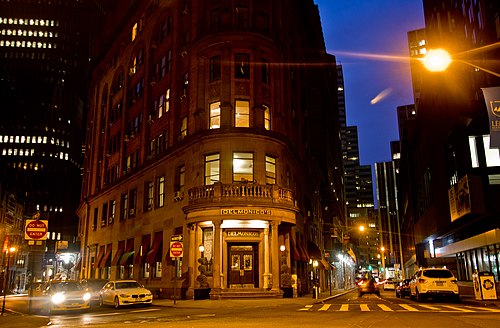
The original Beaver Street location at 56 Beaver (in a building dating to 1891) has been revived under the Delmonico's name several times since, most recently emerging from pandemic-era closure. The Madison Square building itself is long gone; the northwest corner of Fifth and 26th is now occupied by a commercial structure with little to hint at the gastronomic history once served on the site.
Delmonico's operated at 26th St & 5th Ave from 1876 to 1899 — the premier society dining room during the show's setting. Exact corner well-documented.
Books & Tours
Some links are affiliate links — we may earn a small commission at no cost to you.