Fifth Avenue Hotel
200 Fifth Avenue (5th Ave & 23rd St)
About This Location
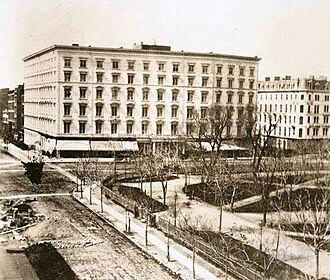
The Fifth Avenue Hotel was the grandest hotel in Gilded Age New York. Opened in 1859 by Amos R. Eno at the corner of Fifth Avenue and 23rd Street, it occupied an entire city block overlooking Madison Square — then the undisputed center of fashionable New York. With six stories of white marble, 530 rooms, and New York's first passenger elevator (called a "vertical railroad"), it was a technological and social marvel that set the standard for American luxury hotels for nearly half a century.
The hotel was more than a place to sleep. Its public rooms functioned as the unofficial parlor of New York's elite — a place where social, political, and financial power converged. Visiting heads of state, presidents, and foreign dignitaries stayed here. The Prince of Wales dined in its restaurants. Wall Street titans, railroad barons, and society queens crossed paths in its corridors daily.
Exact historical address. Demolished 1908; site now 200 Fifth Avenue.
The "Amen Corner" — Political Nerve Center
The hotel's most famous feature was the "Amen Corner" — a section of the lobby corridor where Republican Party bosses held court. Senator Thomas C. Platt, the undisputed boss of New York's Republican machine, conducted his political business here almost daily, granting favors, dispensing patronage, and brokering deals from his regular armchair. The name "Amen Corner" came from the way visiting politicians would nod along — "amen" — to whatever Platt decreed.
Chester A. Arthur was a regular at the Fifth Avenue Hotel before his unexpected ascent to the presidency in 1881. The hotel served as Republican campaign headquarters during multiple presidential elections, including the contentious Blaine–Cleveland contest of 1884, which falls squarely within the timeline of the show's early seasons. Every major political figure in Gilded Age New York passed through these doors.
In HBO's "The Gilded Age"
While the show does not feature the Fifth Avenue Hotel as an explicitly named on-screen venue, its world permeates the series. George Russell's political deal-making in Seasons 2 and 3 — his maneuvering with politicians, backroom negotiations, and quest for influence — mirrors exactly the kind of activity that happened in the hotel's Amen Corner. Russell is essentially doing what Senator Platt's allies did: converting new industrial wealth into political power.
Ward McAllister, the self-appointed social arbiter who coined the phrase "The Four Hundred," was a fixture at the hotel's dining rooms and public spaces. His role in the show as gatekeeper of high society reflects his real-life presence in hotels like this one — cultivating the guest lists and social hierarchies that defined who was "in" and who was not.
Agnes van Rhijn's old-money world would have revolved around Madison Square in the early 1880s — this was where polite society gathered before the northward migration to Murray Hill and the Upper East Side. The charity bazaars, social calls, and public appearances that drive much of the show's drama would have been staged within blocks of this hotel.
Social Life at the Hotel
Beyond politics, the Fifth Avenue Hotel was a stage for Gilded Age social theater. Its dining room was among the finest in New York — a place where being seen mattered as much as what you ate. The hotel hosted lavish banquets, receptions for visiting royalty, and the endless round of social events that marked the New York "season" from October through Lent.
For women of society, the hotel's public rooms were one of the few acceptable places to be seen in public. Ladies' luncheons, afternoon teas, and charity committee meetings took place here regularly. Mrs. Astor and her circle — the very old-guard establishment that Bertha Russell fights to penetrate in the show — would have been familiar faces in these rooms.
The hotel also witnessed the dark side of Gilded Age excess. When it finally closed in 1908, newspapers mourned it as the passing of an era — but by then, fashionable New York had already moved uptown, and newer hotels like the Waldorf-Astoria (opened 1893) had stolen its clientele.
What Stands Here Today
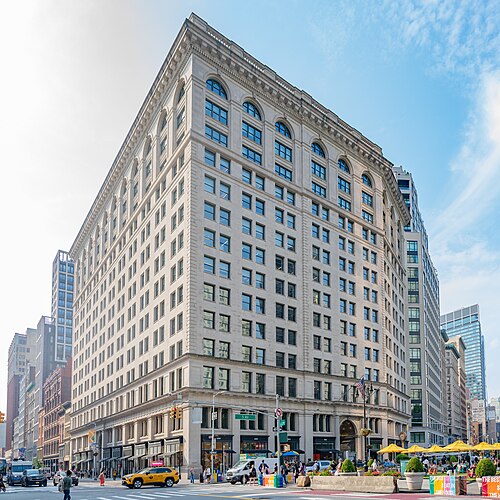
The hotel was demolished in 1908, and the current 200 Fifth Avenue building — a 23-story Renaissance Revival office tower — rose on the site in 1909. For decades it housed the International Toy Center, where toy manufacturers displayed their wares to buyers. In 2010, the building was converted into modern office and retail space.
Today, the ground floor is home to Eataly NYC Flatiron, Mario Batali's sprawling Italian food hall (opened 2010). The upper floors house tech companies and creative offices. Nothing remains of the original hotel, though a historical plaque on the building acknowledges the site's significance. Madison Square Park, directly across the street, still evokes the neighborhood's Gilded Age grandeur.