Madison Square Park
23rd St & 5th Ave
The Crossroads of the Gilded Age
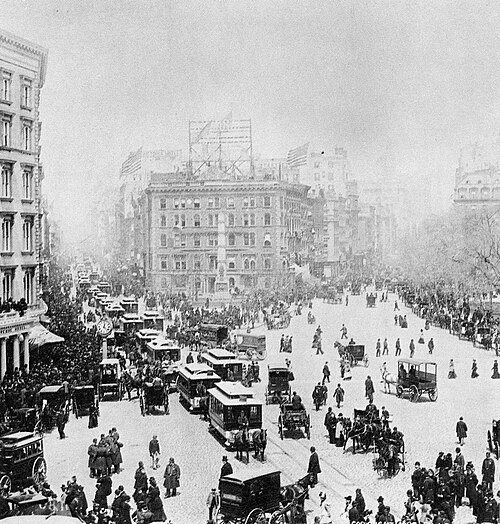
If the Gilded Age had a town square, it was Madison Square. Opened as a park in 1847 and named for President James Madison, the green at the meeting of Broadway, Fifth Avenue, and 23rd Street had become, by the 1870s and 1880s, the exact center of fashionable New York. Around its railings stood nearly everything that mattered: the Fifth Avenue Hotel with its political brokers, the Anglophile Brunswick with its coaching set, Delmonico's at 26th Street where society dined, and the first Madison Square Garden with its rooftop entertainments. The great hotels' guests promenaded its paths; nursemaids wheeled the children of millionaires past flower beds; and in 1880 the surrounding stretch of Broadway received some of the first electric arc lighting in the city, turning the square into a nightly spectacle. To walk across Madison Square in 1882 was to pass, in five minutes, through the drawing room, the dining room, and the stock exchange of American society.
The Torch in the Park
The park's strangest and most beloved ornament was a fragment of a statue. From 1876 to 1882, the completed right arm and torch of the Statue of Liberty stood in Madison Square — shipped over from the Philadelphia Centennial Exhibition while fundraising for the statue's pedestal dragged on. For fifty cents, visitors could climb a ladder inside the arm and stand on the torch balcony, thirty feet above the park, a surreal preview of a monument that did not yet exist. The display was equal parts publicity stunt and civic embarrassment — a giant copper arm marooned in a park while New York's millionaires declined to fund its pedestal — until Joseph Pulitzer's newspaper campaign finally raised the money from ordinary citizens and the statue rose in the harbor in 1886.
In HBO's The Gilded Age
The show depicts the torch display in the park — a scene actually filmed at Washington Park in Troy, New York, whose intact nineteenth-century row houses stand in for 1880s Manhattan. In the series' geography, as in history, Madison Square is unavoidable: Marian Brook, Peggy Scott, and George Russell all move through a neighborhood bounded by the Brunswick Hotel, Delmonico's, and Mrs. Astor's mansion a few blocks north — all separate pins on this map. When characters cross a leafy square between social engagements, this is the square they are crossing.
Madison Square Today
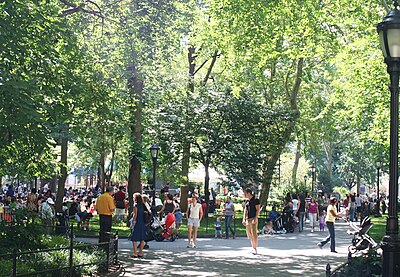
The neighborhood's later landmarks arrived just after the Gilded Age closed: the Flatiron Building rose at the square's southwest corner in 1902, and the Metropolitan Life tower — briefly the tallest building in the world — followed in 1909. The park itself, restored and replanted, is now one of the best-kept small parks in Manhattan, with a celebrated public art program and a permanent crowd at the Shake Shack kiosk in its southeast corner.
Still exists today. Statue of Liberty torch display here is historically documented 1876–1882.
Books & Tours
Some links are affiliate links — we may earn a small commission at no cost to you.