Madison Square Garden
Madison Ave & 26th St
From Train Depot to Pleasure Palace
The story of Madison Square Garden begins not with sport or spectacle but with steam and soot. In 1871, Commodore Cornelius Vanderbilt moved his New York and Harlem Railroad operations uptown to the new Grand Central Depot, abandoning a sprawling passenger shed on the northeast corner of Madison Avenue and 26th Street. The cavernous empty hall was quickly leased to showman P.T. Barnum, who in 1874 reopened it as "Barnum's Monster Classical and Geological Hippodrome," a 10,000-seat arena for chariot races, menageries, and his traveling circus.
After Barnum's lease ended, bandleader Patrick Gilmore took over in 1876, renaming it Gilmore's Garden and installing fountains, flowers, and promenade concerts. William Henry Vanderbilt, who had inherited the property from his father, reclaimed the lease in 1879 and rechristened it Madison Square Garden — the first venue to bear the now-legendary name. This original Garden was a rough-hewn, roofless brick box with poor sightlines and worse ventilation, yet it hosted everything from the National Horse Show to Westminster Kennel Club dog shows to six-day bicycle races and heavyweight prize fights, establishing Madison Square as the epicenter of New York's sporting and amusement world.
Stanford White's Moorish Masterpiece
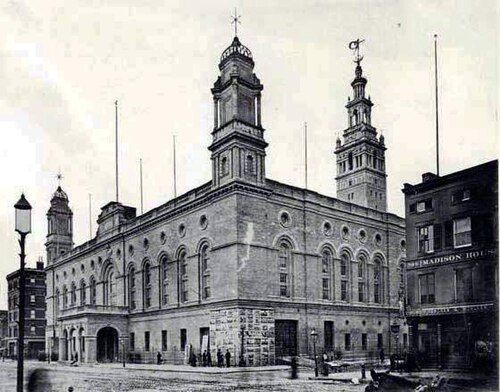
By the late 1880s, the creaky first Garden was losing money, and a syndicate of Gilded Age titans — J.P. Morgan, Andrew Carnegie, P.T. Barnum, W.W. Astor, and Darius Mills among them — pooled their fortunes to build something worthy of the city. They hired the brilliant, dissolute architect Stanford White of McKim, Mead & White, who delivered in June 1890 a yellow-brick and terra-cotta fantasy inspired by the Giralda of Seville. Its 32-story tower was then the second-tallest structure in the city, crowned by Augustus Saint-Gaudens's gilded copper statue of Diana the Huntress — eighteen feet tall, nude, and scandalously visible for miles.
Inside, White packed an astonishing program onto a single block: a 17,000-seat main arena (the largest in the world), a 1,200-seat theater, a concert hall, a restaurant, and most famously a rooftop cabaret where summer audiences sipped champagne under the stars. Moorish arcades, loggias, and arched windows gave the exterior a sensuous, almost Andalusian grace rare in gritty New York. It was the most beautiful building Stanford White ever designed — and, fatally for him, his favorite haunt.
In HBO's The Gilded Age
Madison Square Garden looms over the world of HBO's series as the social and sporting hub every ambitious New Yorker had to be seen at. The original 1879 Garden would have been in its final years during the show's 1882–1883 timeframe, hosting the National Horse Show each November — an event so fashionable that Mrs. Astor, Ward McAllister, and the entire Four Hundred treated its boxes as an extension of the opera-house ritual. Bertha Russell, forever hunting for arenas in which to plant her flag, would certainly have engineered a box there, while George Russell's railroad interests tied him directly to the Vanderbilt syndicate that owned the ground.
Because the Stanford White Garden did not rise until 1890 — well after the show's period — the series has so far referenced the venue more than depicted it. Production has leaned on upstate armories and CGI set extensions when an arena interior is needed, since nothing of the original Madison Square Garden survives. For viewers, the location is best understood as a "ghost site": walk the corner today and imagine the horse show's gaslit promenade, the brass bands, and the rustle of bustles against sawdust.
The Murder and Demolition
On the warm evening of June 25, 1906, Stanford White took his usual seat at the rooftop cabaret for the premiere of the musical revue "Mam'zelle Champagne." Midway through the finale, the Pittsburgh coal heir Harry Kendall Thaw walked up to White's table and fired three shots into his face at point-blank range. Thaw's wife, the former chorus girl and artist's model Evelyn Nesbit, had once been White's teenage mistress — a liaison consummated, according to her later testimony, on the famous red velvet swing in White's hidden apartment. The ensuing trials were branded "the crime of the century," consuming the tabloid press for years and exposing the rotten underside of Gilded Age privilege.
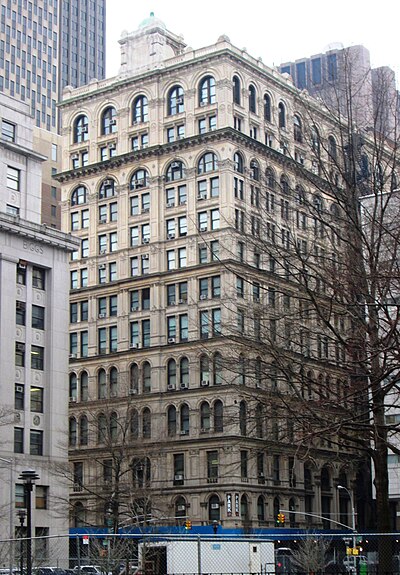
The Garden limped on until 1925, when the New York Life Insurance Company bought the block and commissioned Cass Gilbert to design their new headquarters. Diana was removed and eventually found a home at the Philadelphia Museum of Art, where she still gleams today. Stanford White's masterpiece was reduced to rubble, and a third Madison Square Garden rose on 50th Street and Eighth Avenue.
Historical address precisely known. First MSG (1874–1890) and Stanford White's second MSG (1890–1925) both stood here. Site now occupied by the New York Life Building (Cass Gilbert, 1928).