Mamie Fish's House
25 E 78th St, Upper East Side (estimate)
About This Location
Mamie Fish — born Marion Graves Anthon in 1853 — was one of the most colorful and subversive figures in Gilded Age New York society. Along with Caroline Schermerhorn Astor and Alva Vanderbilt, she formed what contemporaries called the "Big Three" triumvirate of society hostesses who dominated New York's social calendar in the 1890s and early 1900s. But where Mrs. Astor presided with rigid formality and Alva Vanderbilt wielded social power like a blunt instrument, Mamie Fish took a gleefully irreverent approach to the whole enterprise. She was famous for her sharp tongue, her impatience with pretension, and her habit of greeting guests with lines like "Make yourselves at home — and believe me, there is no one who wishes you were there more than I do."
Her husband, Stuyvesant Fish, served as president of the Illinois Central Railroad from 1887 to 1906, which placed the couple firmly in the upper tier of New York wealth. Mamie used that fortune to host some of the most talked-about parties in Gilded Age history. At one dinner she seated her guests alongside a guest of honor who turned out to be a dressed-up doll. At another she threw a lavish banquet for dogs, complete with a diamond-collared canine guest of honor. She hosted a dinner where guests were told to come as their servants, and one where the entertainment was a troupe of trained circus animals in the dining room. Her friend and social chronicler Elizabeth Drexel Lehr recorded many of these events in vivid detail in her 1935 memoir King Lehr and the Gilded Age, which remains one of the best primary sources for understanding Mamie's world.
What made Mamie Fish remarkable was not just her eccentricity but her self-awareness. She understood that the rituals of Gilded Age society were, at some level, absurd — and she reveled in exposing that absurdity while remaining firmly at the center of the social world she mocked.
The Building at 25 East 78th Street
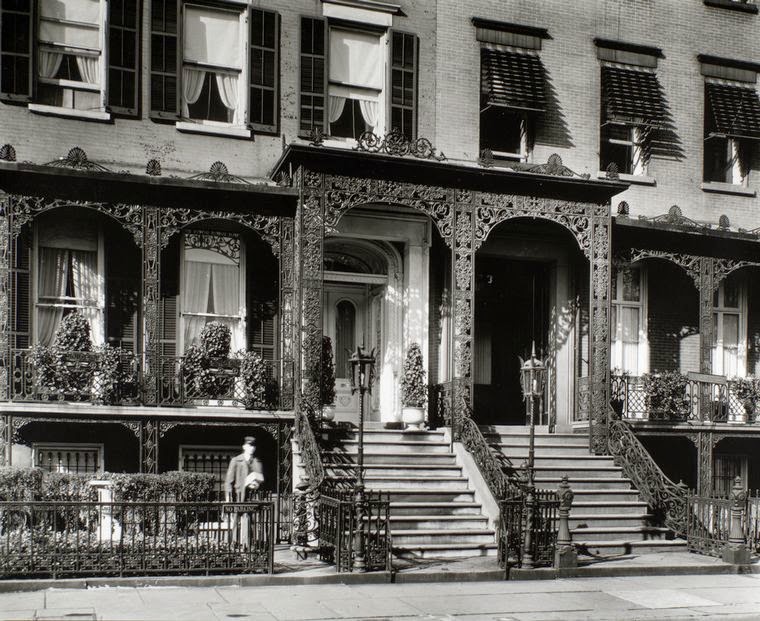
The Fish family's New York residence was located at 25 East 78th Street on the Upper East Side, in the heart of the Lenox Hill neighborhood that attracted many of the city's wealthiest families during the Gilded Age. The original Fish townhouse no longer stands. The block today is occupied by a mix of prewar apartment buildings and townhouses typical of the Upper East Side's residential character.
Confidence is moderate — wealthy New York families of this era frequently maintained multiple residences, and Mamie Fish's Manhattan address is less thoroughly documented than her Newport properties.
Newport Connection
Like all families of their social standing, the Fishes maintained a summer presence in Newport, Rhode Island, where Mamie hosted many of her most legendary entertainments. Their Newport residence was Crossways, a Colonial Revival mansion at 580 Narragansett Avenue designed by Dudley Newton and completed in 1898. However, HBO's The Gilded Age filmed Mamie Fish's interiors not at Crossways but at Chateau-sur-Mer, a magnificent High Victorian mansion on Bellevue Avenue originally built in 1852 for the China trade merchant William Shepard Wetmore. Chateau-sur-Mer, with its richly layered interiors redesigned by Richard Morris Hunt in the 1870s, provided the production with the kind of opulent yet slightly eccentric backdrop that suits Mamie's character perfectly. Both properties are now preserved by the Preservation Society of Newport County and are open for public tours as part of the Newport Mansions collection.
In HBO's The Gilded Age
In The Gilded Age, Mamie Fish is portrayed by Ashlie Atkinson as a scene-stealing presence who brings irreverent humor and warmth to the otherwise tightly corseted world of New York society. The show captures the essential spirit of the real Mamie — her wit, her impatience with social pretension, and her talent for the outrageous dinner party — while naturally condensing and dramatizing events for television. The infamous doll tea party, featured prominently in the series, is drawn directly from historical accounts of the real Mamie Fish's entertainments. The series rightly identifies her as one of the most fascinating women of the era — someone who saw through the gilded surface and chose to laugh rather than conform.