Metropolitan Opera House (original)
Broadway & 39th St
Built by the Excluded
The original Metropolitan Opera House was born of a snub. By the early 1880s, New York's newly minted industrial fortunes — the Vanderbilts, Goulds, Morgans, Rockefellers, and Whitneys — had grown too numerous and too rich for the cramped eighteen boxes of the old Academy of Music on East 14th Street. When Mrs. William Backhouse Astor Jr. and her fellow guardians of the Knickerbocker old guard refused to sell or surrender a box to the likes of Alva Vanderbilt, the excluded millionaires did what Gilded Age money always did: they built something bigger.
In April 1880, sixty-five subscribers each pledged $10,000 (roughly $300,000 today) to incorporate the Metropolitan Opera House Company, Ltd. William Henry Vanderbilt led the list. The site chosen — the full block bounded by Broadway, Seventh Avenue, 39th and 40th Streets — was then considered alarmingly far uptown. Ground broke in 1881, and on the evening of October 22, 1883, the house opened with Gounod's Faust, Italian soprano Christine Nilsson singing Marguerite. Carriages jammed Broadway for blocks. Within a single season, the Academy of Music surrendered; its impresario Henry Abbey famously conceded, "I cannot fight Wall Street." The new money had won the opera war.
The Yellow Brick Brewery
Architect Josiah Cleaveland Cady — better known for the American Museum of Natural History's south wing — won the commission despite having never designed a theater in his life, and it showed. His hulking Italian Renaissance pile of mustard-colored brick and terracotta was immediately nicknamed "the Yellow Brick Brewery." Critics savaged the exterior; Montgomery Schuyler called it graceless. But the priority had never been the facade. It was the boxes.
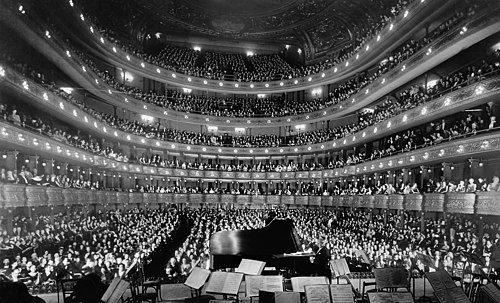
Inside, Cady arranged not one but two tiers of parterre boxes — 122 in total — so that every founding subscriber could be seen. The lower golden tier, draped in crimson and lit by gaslight that glinted off the jewels of its occupants, was instantly christened the "Diamond Horseshoe," a name that would follow the Met to Lincoln Center eighty years later. The auditorium seated 3,615, making it one of the largest opera houses in the world, though the sightlines from the upper galleries were notoriously poor and the acoustics uneven until post-fire renovations improved them. What mattered was the social geometry: on any given Monday night in the subscription season, the Horseshoe displayed the Vanderbilts, Goulds, Morgans, and Whitneys in a single luminous curve — a living catalogue of American capitalism, staged for the city to envy.
In HBO's The Gilded Age
The Metropolitan Opera House is the stage on which Julian Fellowes resolves Season 1's central war. Throughout the season, Bertha Russell (Carrie Coon) — standing in for Alva Vanderbilt and the other excluded new-money wives — has battered unsuccessfully at the doors of Mrs. Astor's society. In the finale, "Let the Tournament Begin," the dueling-opera-houses night dramatizes the real 1883 schism with only modest compression: old New York gathers at the Academy of Music while the Russells and their allies preside over opening night at the new Met. Bertha's masterstroke is securing the Duke of Buckingham as her guest, draining the Academy of its social oxygen. By the final curtain, even Mrs. Astor's daughter has defected uptown.
The show telescopes history — the real Duke figures are invented, and the 1883 opening did not single-handedly break the Academy — but the outcome is accurate: within a year, the Academy abandoned opera entirely. For viewers, the Met becomes shorthand for Bertha's ascendancy, and the series has already gestured toward the golden age to come, when Enrico Caruso would debut there in 1903 and Arturo Toscanini would conduct from 1908, transforming a social battleground into a genuine artistic capital.
Fire, Decline, and Demolition
On August 27, 1892, a stagehand's carelessness sent flames roaring through the auditorium, gutting the interior and nearly killing the company. The boxholders, now organized as the Metropolitan Opera and Real Estate Company, rebuilt within fifteen months, and architect J.B. McElfatrick improved the acoustics that Cady had bungled. The rebuilt house entered its legendary era: Caruso's American debut in Rigoletto on November 23, 1903; Toscanini's tenure beginning 1908; world premieres by Puccini (La Fanciulla del West, 1910) and Humperdinck; the reigns of Geraldine Farrar, Rosa Ponselle, and Kirsten Flagstad.
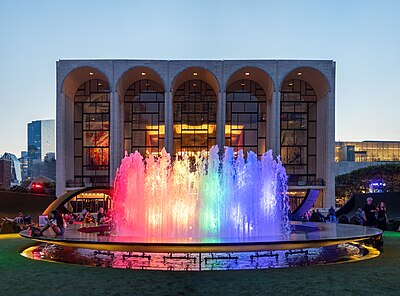
But the building's flaws compounded. Backstage space was impossibly cramped, dressing rooms Dickensian, and by the 1920s management was already lobbying for a replacement. The Depression, two world wars, and failed Rockefeller Center plans delayed relief for forty years. On April 16, 1966, Rudolf Bing led a tearful farewell gala, and the company moved to Wallace Harrison's new house at Lincoln Center. Despite a fierce preservation campaign led by Rudolf Bing himself and Leopold Stokowski, the old Met was demolished in 1967 — a loss that helped galvanize New York's landmarks preservation movement.
Exact historical address at Broadway & 39th St. Opened October 22, 1883. Demolished 1967 after company moved to Lincoln Center in September 1966.
Books & Tours
Some links are affiliate links — we may earn a small commission at no cost to you.