Sherry's Restaurant
6th Ave & 38th St (approximate)
Louis Sherry's Rise
Louis Sherry began as a waiter and worked his way up through New York's hotels before opening his own small restaurant and confectionery in 1881, in the West 30s near Sixth Avenue. His timing was perfect. Society was migrating uptown, its appetite for French cooking and elaborate entertaining was growing with its fortunes, and the only name in luxury dining — Delmonico's — suddenly had a challenger with flawless taste and ferocious ambition. Sherry made his reputation first as a caterer to the Newport cottage set, handling the balls and dinners of the same families the show portrays, and then built his restaurant into Delmonico's only true rival. For the rest of the century the two names were spoken as a pair: a hostess was a Sherry's woman or a Delmonico's woman, and the choice said something about her.
Dinners as Theater
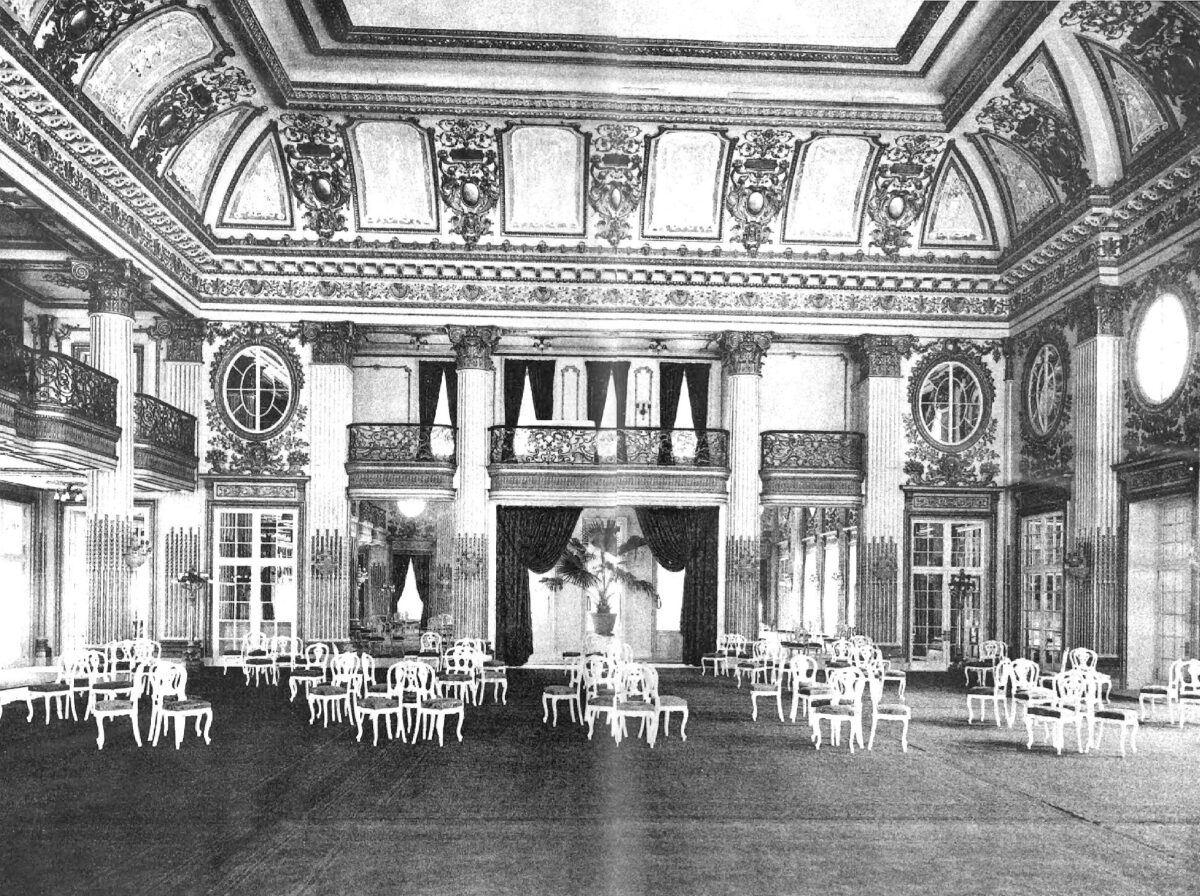
Sherry's became the stage for some of the most extravagant — and notorious — entertainments in American history, especially after Sherry followed society uptown in 1898 to a Stanford White-designed palace at Fifth Avenue and 44th Street, directly across from Delmonico's newest home. It was there in 1903 that C.K.G. Billings hosted his infamous Horseback Dinner, with mounted guests dining in the ballroom from trays fixed to their horses' withers. And it was there in 1905 that James Hazen Hyde threw the French costume ball whose reported extravagance triggered an insurance-industry scandal and investigation. Every such spectacle validated what the Gilded Age already knew: at Sherry's, dinner was performance, and the seating chart was the review.
In HBO's The Gilded Age
In the show's Seasons 1 and 2, Sherry's appears as one of the fashionable dining rooms where George Russell and Ward McAllister conduct the social business of the age — and where even Agnes van Rhijn must occasionally be seen. The series accurately captures what dining at Sherry's meant: a public declaration of standing, scrutinized in the next morning's papers for who sat with whom, who was invited, and who conspicuously was not. For a family like the Russells, a well-placed table at Sherry's was a campaign maneuver as deliberate as any ball.
Prohibition and Afterlife
Louis Sherry closed his great restaurant in 1919, declaring that Prohibition had made luxury dining impossible — fine French cooking without wine, he reasoned, was a contradiction in terms. But the name proved durable: it survived on boxes of Louis Sherry chocolates in their signature orchid tins, in the Sherry-Netherland hotel on Fifth Avenue, and in the wine trade. The original 1880s location near 38th Street and Sixth Avenue left no trace; this map's pin marks its approximate site in what is now the Garment District.
Louis Sherry's first restaurant (opened 1881) was at 38th St & 6th Ave (approximate). He later moved to the celebrated 5th Ave & 44th St location in 1898.