S4 Filming — Stone Street Area, Financial District (Fan-spotted)
South William St, Mill St & Stone Street, Financial District
About This Location
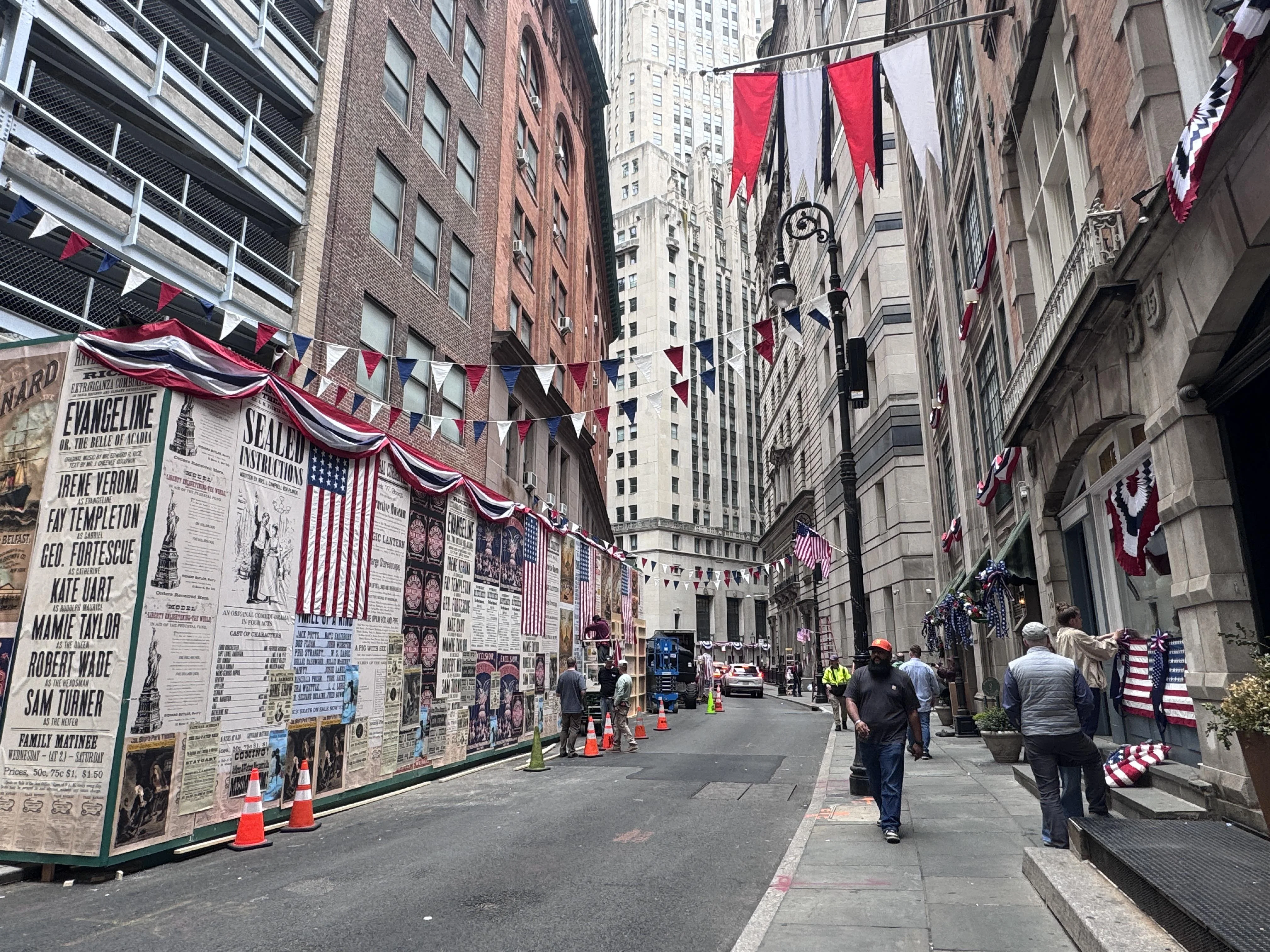
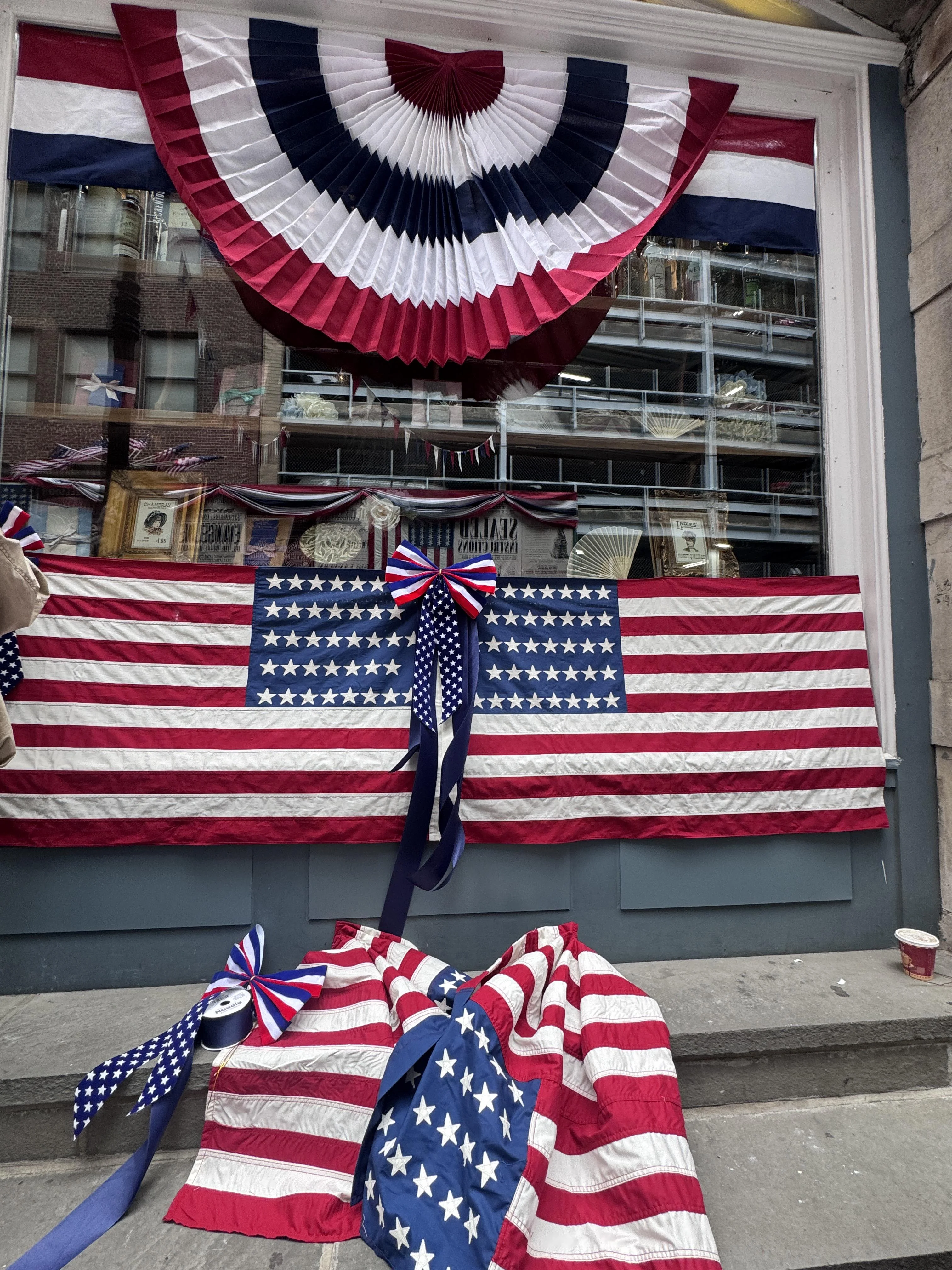
Reddit user u/BlueJeanBaby718 photographed extensive Season 4 set dressing across South William Street, Mill Street, and Stone Street in the Financial District. The production transformed these narrow cobblestone lanes into a vivid 1880s streetscape complete with red-white-and-blue bunting, period-correct 38-star American flags, and walls plastered with meticulously reproduced Gilded Age ephemera.
The scale of the set dressing — spanning multiple blocks with theater playbills, patent medicine advertisements, railroad timetables, and patriotic decorations — suggests a major street-level sequence, possibly a parade, public celebration, or bustling commercial district scene. Production crew and equipment are clearly visible in the photos, confirming active filming.
Fan photos by Reddit user u/BlueJeanBaby718 show extensive period set dressing across South William Street, Mill Street, and Stone Street — including 1880s theater playbills, 38-star American flags, patriotic bunting, patent medicine advertisements, and railroad posters. Active production crew and equipment visible on the street.
The 38-Star Flag
The American flags visible in the set dressing carry 38 stars — a precise period detail that places the scene between 1876 and 1889. Colorado was admitted as the 38th state on August 1, 1876, and the flag carried 38 stars until North Dakota, South Dakota, Montana, and Washington were admitted in November 1889, bringing the count to 42. Since The Gilded Age is set in the early-to-mid 1880s, the 38-star flag is exactly correct. The production team's attention to this detail is characteristic of the show's rigorous approach to period authenticity — Julian Fellowes and his team have consistently prioritized getting the visual fabric of the era right, from table settings to street-level signage.
The Prop Posters: Real People, Real Shows
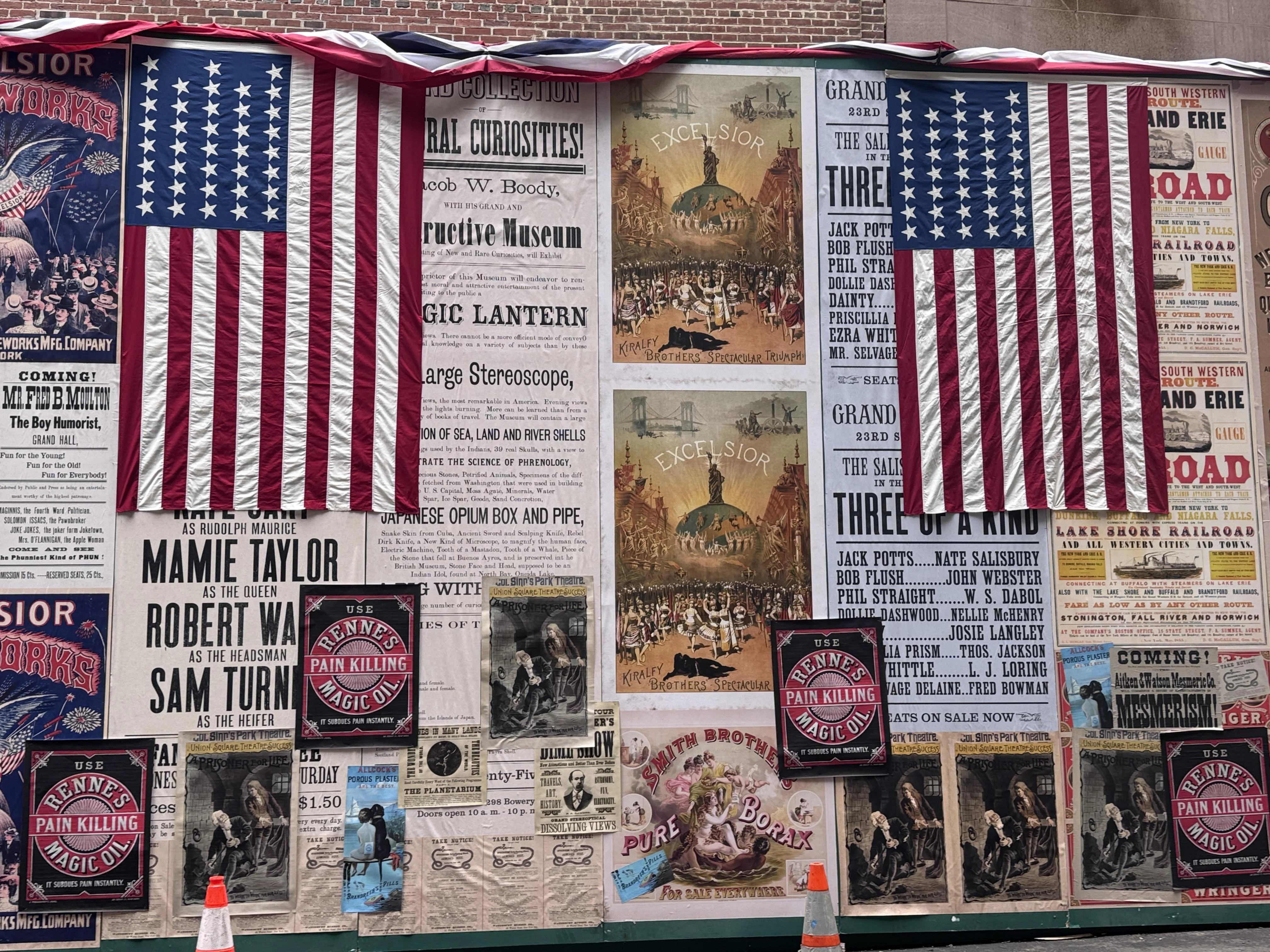
The wall of theater playbills and advertisements visible in the photos is packed with names and products drawn directly from the 1880s. Several are identifiable:
"Evangeline" — a burlesque opera (subtitled "The Belle of Acadia") that premiered at Niblo's Garden in New York in 1874. It became one of the most successful musical productions of the decade, running for years and touring nationally. A poster for "Evangeline" on an 1880s New York street would have been entirely commonplace.
Fay Templeton — one of the most famous actresses and singers of the Gilded Age. Born in 1865, she debuted on stage as a child and by the 1880s was a leading lady in comic opera and burlesque. She later starred in Weber and Fields' Broadway productions and George M. Cohan's musicals. Her name on a theater bill places this scene squarely in the world the show depicts.
Mamie Taylor — another name visible on the playbills. In the real Gilded Age, "Mamie Taylor" was also the name of a popular cocktail (Scotch, lime, and ginger beer) invented around the turn of the century — though the poster here appears to reference a performer.
Smith Brothers Cough Drops — the iconic bearded-men packaging is visible in the prop advertisements. William and Andrew Smith began selling their cough drops from a Poughkeepsie candy shop in 1847, and by the 1880s the product was nationally distributed. The Smith Brothers were among the first companies in America to use a trademark on their packaging.
Renner's Pain Killing Magic Oil — a patent medicine advertisement typical of the era. The 1880s were the golden age of patent medicine in America, before the Pure Food and Drug Act of 1906 began regulating such products. Advertisements for cure-all tonics, liniments, and "magic oils" were ubiquitous on walls, fences, and in newspapers.
Lake Shore Railroad — the Lake Shore and Michigan Southern Railway was one of the major trunk lines connecting New York to the Midwest. By the 1880s it was controlled by the Vanderbilt family (through the New York Central system) and was one of the busiest rail corridors in America. A Lake Shore timetable poster on a Lower Manhattan wall connects directly to the world of George Russell and the railroad barons who dominate the show's storyline.
"Natural Curiosities" and Magic Lantern shows — the posters advertising a "Instructive Museum," "Magic Lantern," and "Large Stereoscope" reflect the popular entertainment of the pre-cinema era. Before motion pictures, magic lantern shows (projected glass slides) and stereoscopic viewers were the closest thing to visual mass media. Dime museums displaying "natural curiosities" drew enormous crowds in 1880s New York — P.T. Barnum's American Museum on Broadway had been the most famous, though it burned down in 1868.
Stone Street: Manhattan's Oldest Paved Street
Stone Street holds the distinction of being the first paved street in New Amsterdam — the Dutch colonial settlement that preceded New York. In 1658, the street was paved with cobblestones by brewer Abraham Pietersen Verplanck, and it has carried the name "Stone Street" ever since. Originally called Hoogh Straet (High Street) by the Dutch and later Brouwer Straet (Brewer Street), it was renamed after its distinctive pavement.
By the 1880s, the Stone Street area was in the heart of New York's commercial district — surrounded by counting houses, import firms, and the offices of the merchants and financiers who feature so prominently in The Gilded Age. The nearby Hanover Square was one of the city's most prestigious business addresses. The narrow, winding streets of this neighborhood — laid out on the irregular Dutch colonial grid rather than the later Manhattan street plan — give it a distinctly European character that sets it apart from the wider avenues uptown.
Today the Stone Street Historic District is a New York City Landmark, and the block between Mill Lane and Hanover Square has been restored as a pedestrian zone. The cobblestones underfoot, the low-rise brick and stone buildings, and the narrow proportions of the street make it one of the most filmable period locations in Manhattan — and a logical choice for a show that needs to recreate the commercial streetscape of 1880s New York.
Fan Sighting
Spotted by u/BlueJeanBaby718 on Reddit — View original post
"All the photos I posted are taken on South Williams, Mill Street, or Stone Street!!"