Fulton Ferry Landing
Fulton St, Brooklyn (at East River)
The Oldest Crossing in New York
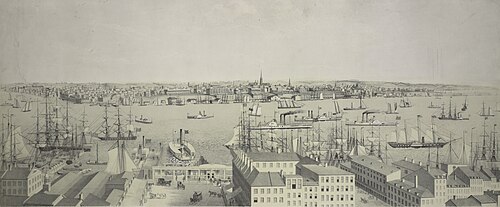
A ferry has crossed the East River at this spot since 1642, when a Dutch settler began rowing passengers between the villages of New Amsterdam and Breuckelen. The crossing entered the modern age in 1814, when Robert Fulton's steam ferry made the trip reliable in all weathers — the service and the streets at both landings took his name. By the Gilded Age, the Fulton Ferry was the busiest river crossing in America, a continuous shuttle of double-ended steamboats carrying tens of millions of passengers a year: clerks and merchants bound for Wall Street, farmers with produce for the Manhattan markets, and everyone else who lived on one side of the river and worked on the other. The ornate Victorian ferry house at the foot of Fulton Street was as much a piece of civic infrastructure as Grand Central Depot uptown.
Brooklyn's Front Door
It is easy to forget that in the 1880s Brooklyn was not part of New York at all — it was an independent city, the third largest in the United States, with its own mayor, newspapers, and high society. The ferry was what stitched the two cities together, and it shaped Brooklyn profoundly: Brooklyn Heights, on the bluff above the landing, grew into America's first commuter suburb because the boats made a Manhattan office reachable from a quiet Brooklyn parlor. Walt Whitman, who crossed here countless times as a Brooklyn newspaperman, made the ride immortal in "Crossing Brooklyn Ferry." And for Brooklyn's Black community — including the prosperous, professional world the show's Scott family belongs to — the ferry was the daily bridge between Brooklyn respectability and Manhattan opportunity.
In HBO's The Gilded Age
Before the Brooklyn Bridge opened in May 1883, this is how Peggy Scott traveled between her family's Brooklyn home and her work in Manhattan — first at the van Rhijn house, then at T. Thomas Fortune's newspaper office. The show's first season builds toward the bridge's opening, and the ferry is the world the bridge ended: the moment the towers and cables went up next door, the boats' days were numbered. Ridership drained away year by year until the ferry ceased regular service in 1924, after 282 years of continuous operation.
The Landing Today
The old ferry slip survives as Fulton Ferry Landing, a small waterfront plaza in the shadow of the Brooklyn Bridge, now the front porch of Brooklyn Bridge Park. Lines from Whitman's poem are set into the railing at the water's edge. With Bargemusic and the River Café moored alongside and the ice cream line at the old fireboat house, it is one of the most pleasant spots in the city to stand where Peggy Scott would have boarded — looking across at the same skyline-framing sweep of river, with the bridge that changed everything directly overhead.
The Fulton Ferry was the primary Brooklyn–Manhattan crossing before the Brooklyn Bridge opened in 1883. Landing at the foot of Fulton Street, Brooklyn — precise historical location.
Books & Tours
Some links are affiliate links — we may earn a small commission at no cost to you.