Van Rhijn & Russell Houses
5th Ave & 61st St
About This Location
The show's central stage — Agnes van Rhijn's old-money brownstone faces the Russells' palatial new mansion across 61st Street. Their proximity drives the entire social drama of the series. The Van Rhijn brownstone represents the older, restrained style of Knickerbocker families who had lived on Fifth Avenue for generations and viewed the new mansions as vulgar displays of wealth. The Russell mansion, by contrast, is a deliberate provocation — a palatial statement of new-money ambition planted directly in old-money territory.
Show explicitly names this corner. The NE corner of 61st & 5th Ave is historically documented.
The Real Vanderbilt House
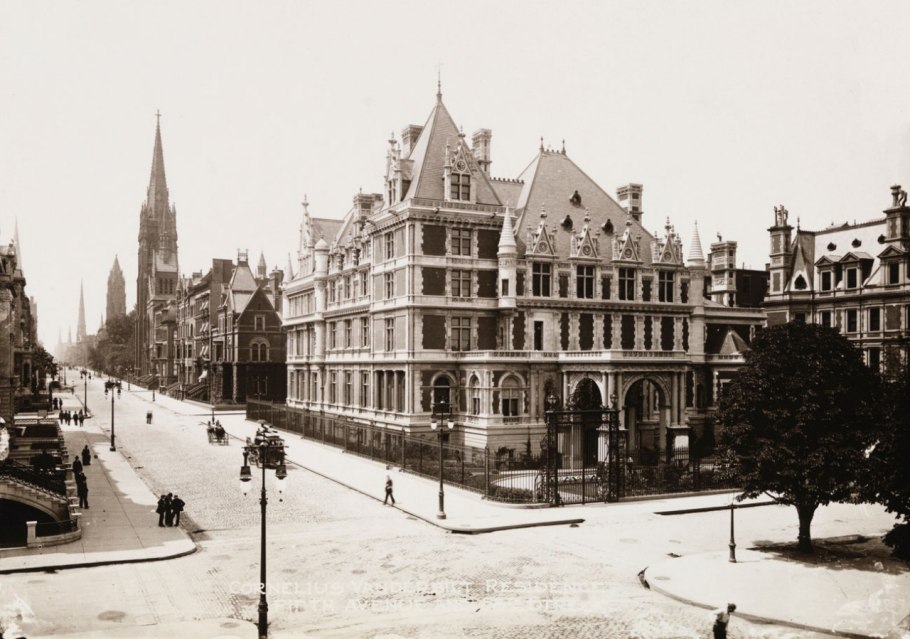
The Russell mansion is directly inspired by the Cornelius Vanderbilt II mansion at 1 West 57th Street — the largest private residence ever built in Manhattan. The original house was designed by George B. Post and completed in 1882 as a red-brick Queen Anne-style dwelling. Beginning in 1893, the Vanderbilts commissioned Richard Morris Hunt — the same architect behind the Biltmore Estate and the base of the Statue of Liberty — to massively expand the house into a French Renaissance chateau that eventually consumed the entire blockfront from 57th to 58th Street along Fifth Avenue. By the time the expansion was complete in 1895, the mansion boasted approximately 130 rooms, including a two-story ballroom, a vast art gallery, and a grand staircase that rivaled anything in the palaces of Europe.
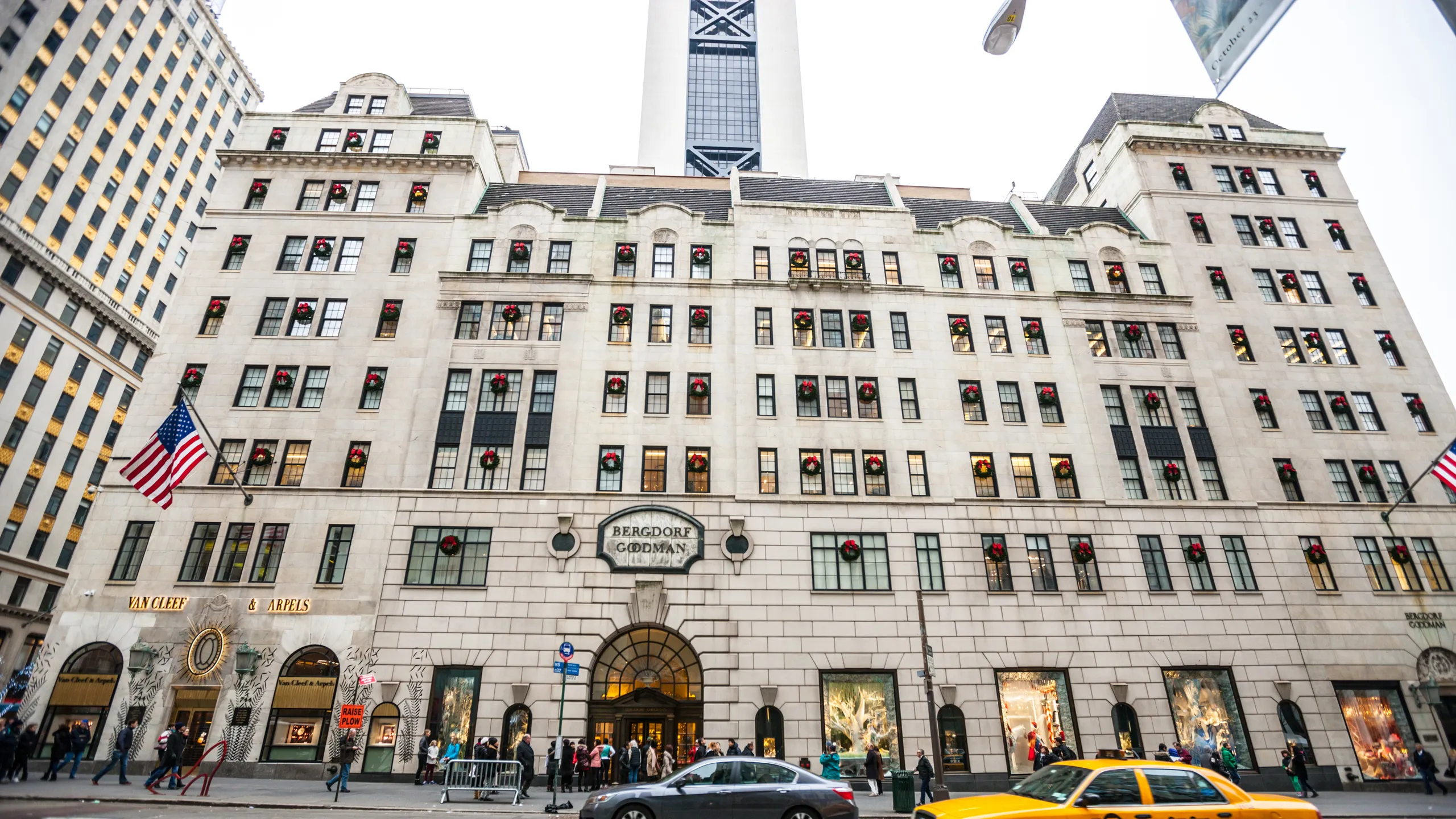
Alice Gwynne Vanderbilt was known as a more dignified figure than her flamboyant sister-in-law Alva, hosting restrained but magnificent entertainments in the ballroom and maintaining a household staff that numbered in the dozens. Cornelius II suffered a debilitating stroke in 1896 and died in 1899 at just fifty-five, leaving Alice as custodian of the great house. The mansion was demolished in 1926–1927 to make way for the Bergdorf Goodman department store, which opened on the site in 1928. The demolition shocked even a city accustomed to reinvention — the grandest private home in New York had survived barely forty years.
Old Money vs. New Money on Fifth Avenue
The social war at the heart of HBO's The Gilded Age was drawn directly from life. For decades, Fifth Avenue south of Central Park belonged to the established Knickerbocker families — the Astors, the Schermerhorns, the Joneses, the Rhinelanders — old Dutch and English families who traced their wealth and social standing back generations and viewed the display of riches as vulgar. When the Vanderbilts, flush with railroad millions, began building their palatial chateaux along Fifth Avenue in the late 1870s and 1880s, it was nothing short of an invasion. The stretch from roughly 50th to 80th Street became known as "Millionaire's Row," lined with mansions that grew ever more ornate as new-money titans competed to outbuild one another. The decisive moment came in 1883, when Alva Vanderbilt held her legendary costume ball at 660 Fifth Avenue and effectively forced Mrs. Astor to acknowledge the family socially — a capitulation the show dramatizes brilliantly through Bertha Russell's campaign against the old-guard establishment.
Filming Location
None of the houses audiences see on screen actually stand in Manhattan. The production built an entire 1880s-era streetscape on the grounds of the Museum of American Armor in Old Bethpage, Long Island. Production designer Bob Shaw and his team constructed the facades with historically accurate stonework, ironwork, and gas lamp fixtures, though only the front faces of the buildings are fully realized — behind them are the steel frameworks and scaffolding of a film set. The Long Island location was chosen because it offered enough open land to build a convincing city block while remaining within practical distance of the show's other filming locations in New York, Connecticut, and Rhode Island. The backlot has been expanded and refined across multiple seasons, becoming one of the most elaborate standing sets in current television production.
What Remains Today
Remarkably, fragments of the Cornelius Vanderbilt II mansion survive scattered across New York City. The mansion's grand iron entrance gates were salvaged before demolition and donated to Central Park, where they now stand at the Conservatory Garden entrance at Fifth Avenue and 105th Street — still one of the most photographed spots in the park. Sculptural limestone reliefs from the mansion's facade were incorporated into the exterior of the Sherry-Netherland Hotel at 781 Fifth Avenue, just a few blocks north of the original site. One of the mansion's massive carved-stone fireplaces was acquired by the Metropolitan Museum of Art, where it is installed in the American Wing. At the site itself, Bergdorf Goodman occupies 754 Fifth Avenue. Nothing about the sleek retail temple hints at the French Renaissance chateau that once towered there — but if you walk into Central Park at 105th Street and pass through those ornate iron gates, you are touching something the Vanderbilts touched every day.
Books & Tours
Some links are affiliate links — we may earn a small commission at no cost to you.