Washington Square Park
5th Ave & Waverly Place
From Potter's Field to Parade Ground
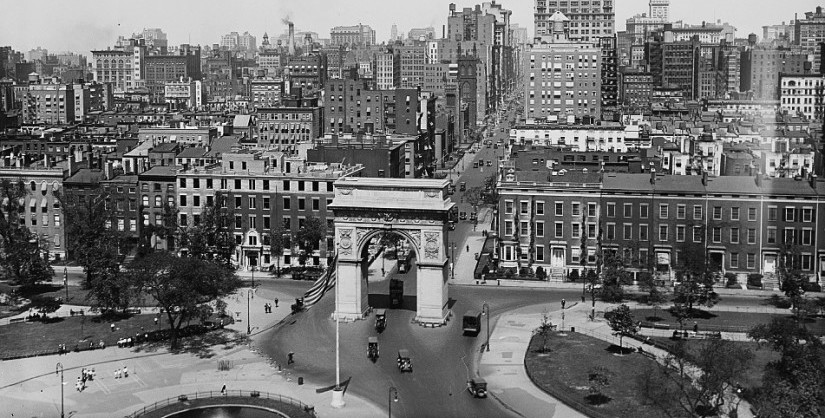
Washington Square began as the least fashionable ground imaginable. In the 1790s the marshy land beside Minetta Brook became the city's potter's field, where thousands of New York's poor and unclaimed dead — many of them victims of the yellow fever epidemics — were buried in unmarked graves that remain beneath the lawns today. In 1826 the city closed the burial ground and converted it into a military parade ground, and within a year it was landscaped as a public square. The transformation was immediate and dramatic: land facing the new square became some of the most desirable in the city, and the square itself became the anchor of a neighborhood that would define old New York respectability for a century.
The Row and Old New York
Along the square's north side rose "The Row" — the red-brick Greek Revival townhouses built in the early 1830s that still constitute one of the finest surviving streetscapes of pre-Civil War New York. These were the houses of the old mercantile aristocracy: Rhinelanders, Delanos, and their kind, families whose money was old enough to predate the railroads and who regarded the palaces rising on upper Fifth Avenue with polite horror. This is precisely the world Henry James anatomized in his 1880 novel Washington Square, drawing on his own grandmother's house at No. 18. By the 1880s — the years of the show — Washington Square stood for everything the new money was trying to buy its way past: quiet, lineage, and the conviction that a brownstone front parlor mattered more than a marble ballroom.
Stanford White's Arch
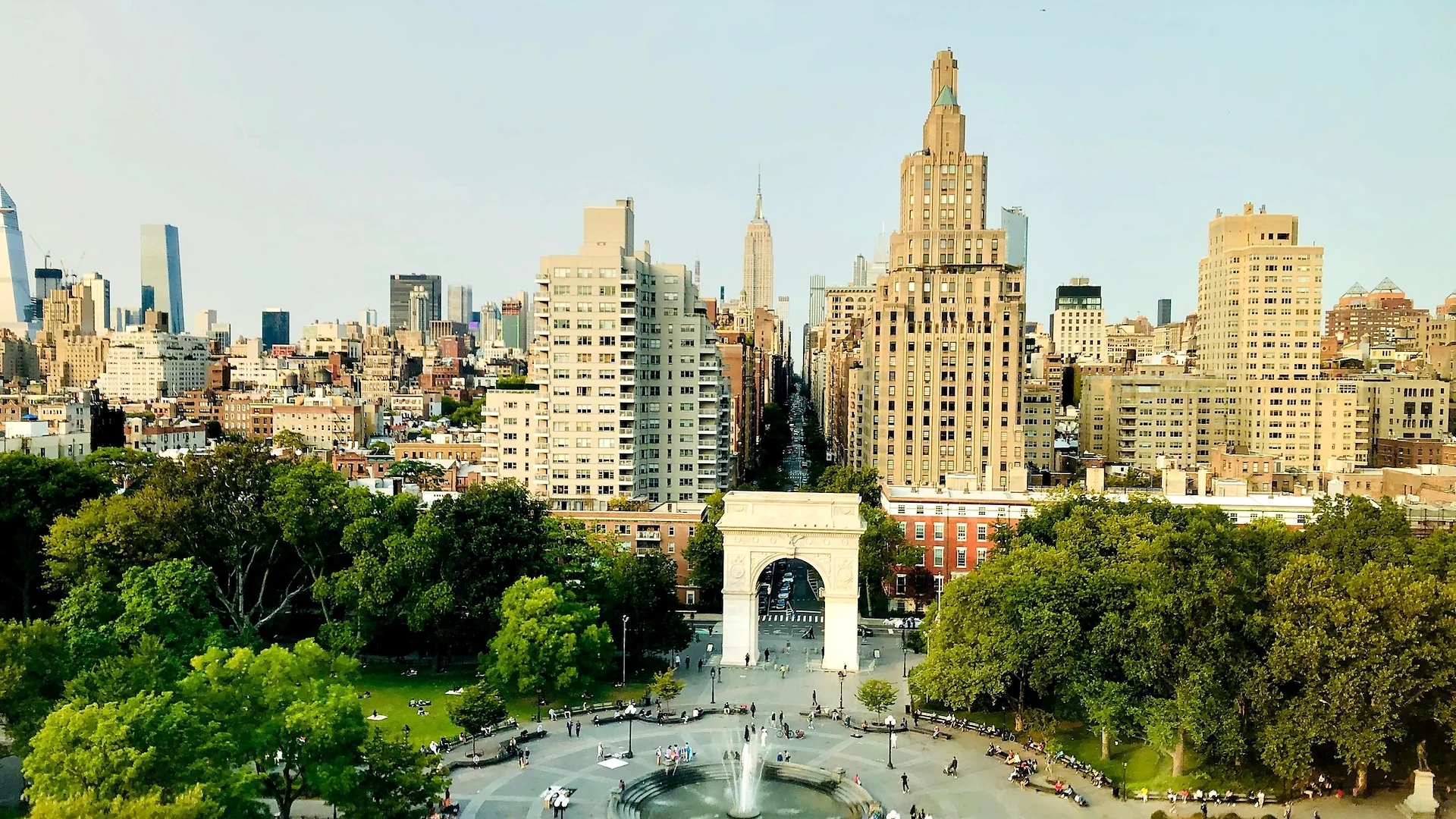
In 1889 New York celebrated the centennial of George Washington's inauguration, and the architect Stanford White designed a temporary triumphal arch of wood and plaster spanning Fifth Avenue just north of the square. It was meant to stand for weeks; New Yorkers loved it so much that a campaign began almost immediately to rebuild it permanently. White's marble arch — taller, grander, and aligned as the ceremonial gateway to Fifth Avenue — was completed in 1892 and dedicated in 1895. The two statues of Washington on its north face, as general and as president, were added in the 1910s. The arch made the square the symbolic foot of Fifth Avenue: every subsequent mansion, hotel, and parade up the avenue implicitly began here.
In HBO's The Gilded Age
Stanford White appears in the series as a character — the fashionable architect commissioned to design the Russell mansion, just as the real White and his firm McKim, Mead & White designed houses, clubs, and monuments for the era's new fortunes. The show captures him in his ascendancy, decades before his sensational 1906 murder at Madison Square Garden (another building he designed, and another pin on this map). Washington Square itself functions in the show's geography the way it did in life: the emblem of the old, settled New York downtown, against which the uptown ambitions of families like the Russells are measured.
Still exists. Stanford White's marble arch (1892) still stands at this exact location.
Books & Tours
Some links are affiliate links — we may earn a small commission at no cost to you.