Brooklyn Bridge
East River, Manhattan entrance
The Great Bridge
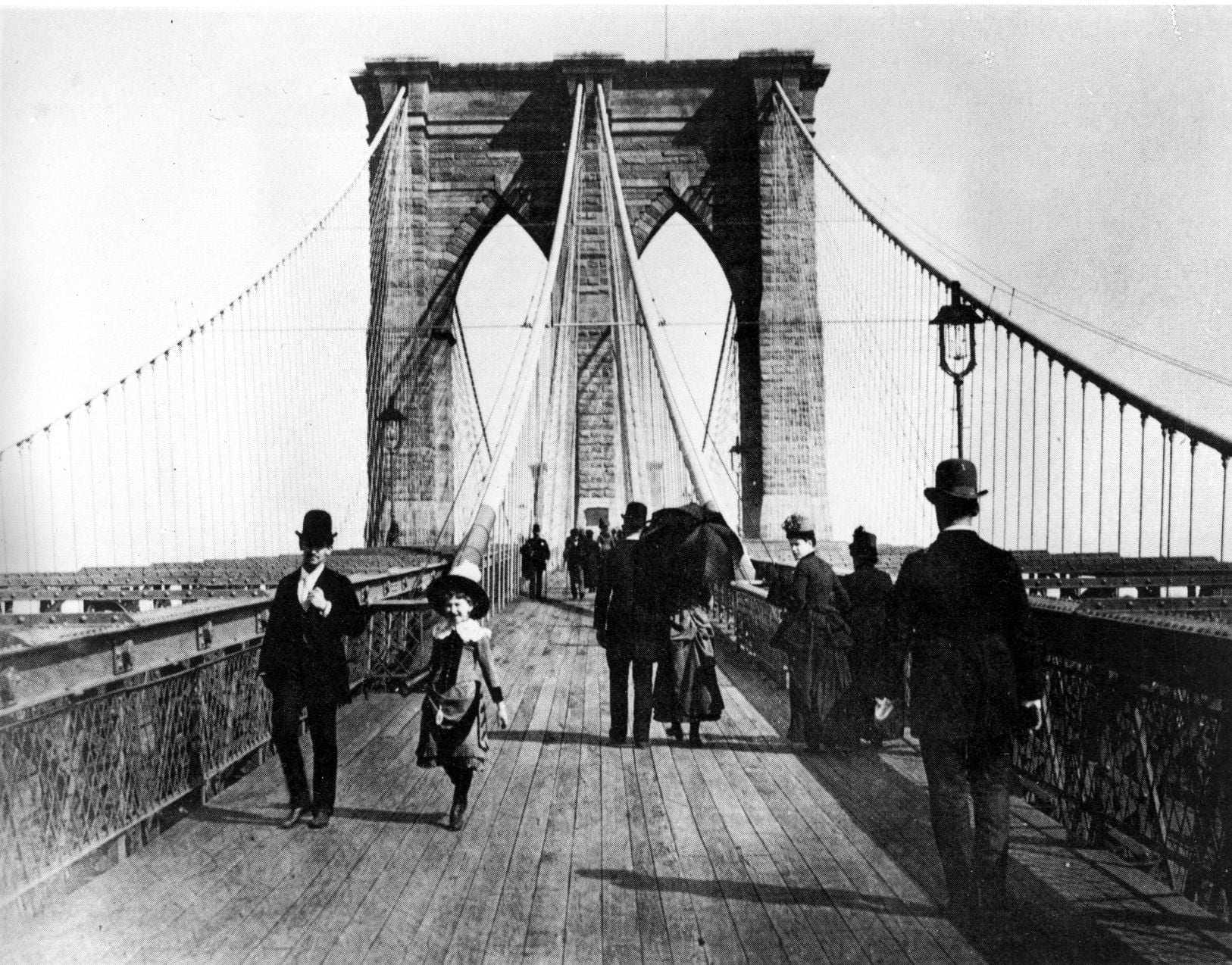
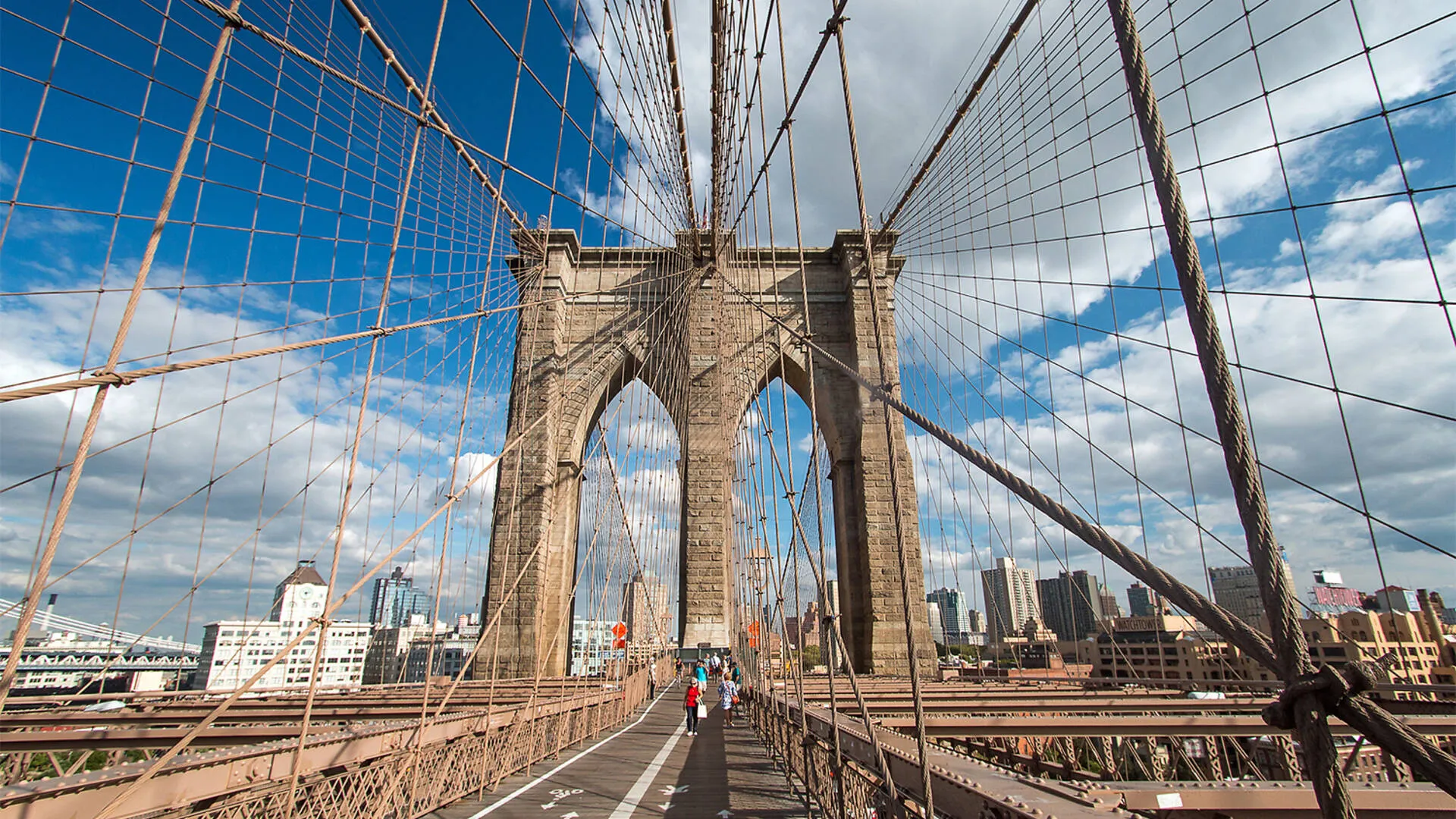
When it opened on May 24, 1883, the Brooklyn Bridge was the longest suspension bridge on earth, its granite towers the tallest structures in North America after Trinity Church's spire, and its four steel cables the first ever used in a great bridge. It had taken fourteen years and a terrible toll. Designer John A. Roebling died of tetanus in 1869 after a ferry crushed his foot while he surveyed the site; his son Washington Roebling took over, only to be permanently disabled by caisson disease — the bends — contracted in the pressurized chambers where workers dug the tower foundations beneath the river. More than twenty workers died in the caissons, on the towers, and among the cables. What they built connected two of the largest cities in America and made the modern metropolis conceivable: the consolidation of Brooklyn into Greater New York in 1898 began, in every meaningful sense, on this roadway.
Emily Warren Roebling
With her husband confined to a sickroom overlooking the site, Emily Warren Roebling became the bridge's indispensable figure — and the show references her for good reason. Over eleven years she taught herself mathematics, cable construction, and materials science, carried Washington's instructions to the engineers, and increasingly handled the engineering correspondence and negotiations herself, becoming the bridge's de facto chief engineer in the eyes of many who worked on it. When politicians moved to remove her husband, it was Emily who addressed the American Society of Civil Engineers in his defense — reportedly the first woman to do so. On opening day she rode across first, carrying a rooster as a symbol of victory. In an era when women could not vote, the century's greatest engineering feat was completed under a woman's supervision.
In HBO's The Gilded Age
The bridge's opening is a great set-piece of Season 2, and the show gives the story to exactly the right character: Peggy Scott, working as a journalist, experiences the opening as transformative — professionally, as a reporter covering the story of the age, and personally, as a Brooklynite watching her city bound permanently to Manhattan. The real opening was declared "The People's Day": schools closed, President Chester Arthur walked across, and fireworks burst over the towers. The celebration had a dark coda — six days later a panic on the crowded promenade killed twelve people — and a showman's epilogue, when P. T. Barnum marched twenty-one elephants across in 1884 to prove the span sound. For the Scott family, whose Brooklyn home and Manhattan ambitions this map traces, no structure mattered more.
Walking It Today
The bridge still carries traffic and thousands of walkers daily, and crossing its wooden promenade remains one of New York's great free experiences. Start on the Brooklyn side near Fulton Ferry Landing — another pin on this map, where Peggy's pre-bridge crossings began — and walk toward Manhattan in the morning with the skyline ahead of you. The Gothic arches, the web of cables, and the plaque honoring Emily Warren Roebling are all exactly where the Gilded Age left them.
Still standing. Opened May 24, 1883. Exact coordinates known.
Books & Tours
Some links are affiliate links — we may earn a small commission at no cost to you.