Hoffman House Hotel
Broadway & 25th St
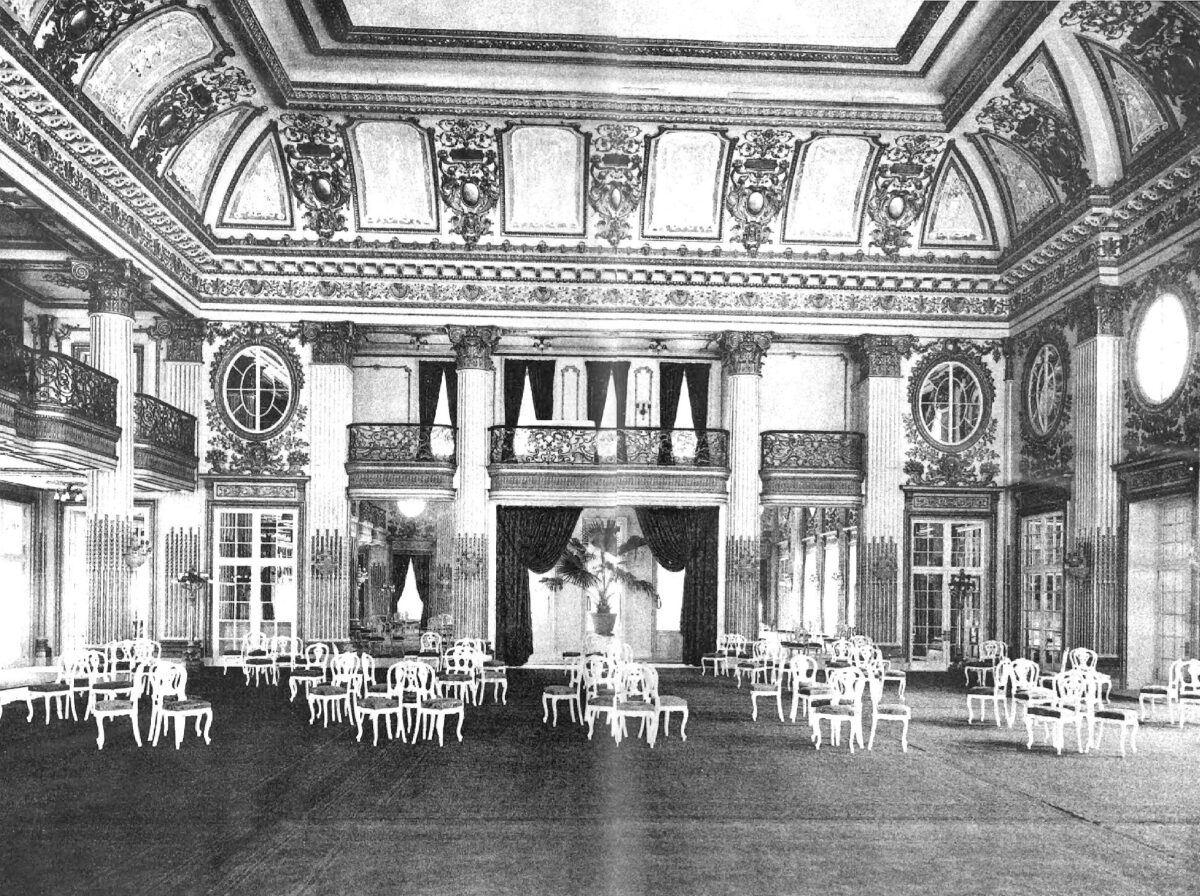
The Palace Bar of Madison Square
The Hoffman House opened in 1864 on the west side of Broadway between 24th and 25th Streets, facing Madison Square at the exact moment that neighborhood was becoming the fashionable heart of New York. By the 1880s it ranked among the most celebrated hotels in America — not primarily for its rooms, which were luxurious enough, but for its Grand Bar, a cathedral of mahogany, marble, and cut glass that functioned as the unofficial clubhouse of Gilded Age male society. Actors, financiers, sportsmen, and politicians drank side by side beneath its frescoed ceilings. Where the Fifth Avenue Hotel across the square leaned Republican, the Hoffman House was famously Democratic territory: Tammany chieftains held court in its corridors, and Grover Cleveland made the hotel his New York headquarters, following the returns there on election night in 1892 as the results made him the only president ever to win two non-consecutive terms.
The bar's presiding spirit was one of the most notorious figures of the age. Edward S. Stokes, a part-owner of the hotel from the early 1880s, had served time for shooting the flamboyant financier Jim Fisk in 1872 — one of the era's most sensational crimes. As a hotelier, Stokes poured his energy into making the Hoffman House bar the most talked-about room in New York, and he succeeded spectacularly.
Nymphs and Satyr
The centerpiece of Stokes's showmanship was a painting. In 1882 he paid a headline-making sum — reported at just over ten thousand dollars — for Nymphs and Satyr, a monumental canvas by the French academic master William-Adolphe Bouguereau depicting four nymphs teasing a satyr into a woodland pool. Hung beneath a crimson velvet canopy and lit so that it glowed against the dark paneling, the painting became the most famous artwork in any American saloon. Gentlemen came from across the country to see it over a glass of the hotel's celebrated cocktails; ladies, barred from the bar in the ordinary course of things, were admitted on designated mornings to view the picture. The image was so identified with the hotel that it appeared on Hoffman House cigar boxes, carrying a slightly scandalous slice of French art into shops and parlors across America.
In HBO's The Gilded Age
The Hoffman House appears in Seasons 2 and 3 as a natural habitat of the show's men of affairs — the sort of place where George Russell could take a meeting that was too delicate for the office, and where Ward McAllister could gather intelligence over terrapin and champagne. The show uses it the way New York actually did: as the masculine counterpart to the drawing rooms the women command. In an era when respectable women did not enter barrooms, spaces like the Hoffman House were where railroad deals were struck, political slates were settled, and reputations were made and unmade — a shadow parliament of the Gilded Age conducted through cigar smoke.
Decline and Demolition
The Hoffman House's fortunes were tied to Madison Square, and when fashion moved uptown after the turn of the century, the hotel's gilded clientele went with it. The grand hotels rising in the 40s and 50s along Fifth Avenue made the marble palaces of the 1860s look like relics, and the Hoffman House closed its doors in 1915 before falling to the wrecking ball. Its great painting outlived it handsomely: Nymphs and Satyr spent years in storage before being acquired by Sterling Clark, and today it hangs in the Clark Art Institute in Williamstown, Massachusetts — still drawing crowds, just as it did above the mahogany bar on Broadway.
Period address 1182–1190 Broadway, well-documented. Demolished 1915.