Central Park — Bethesda Fountain
Mid-park at 72nd St
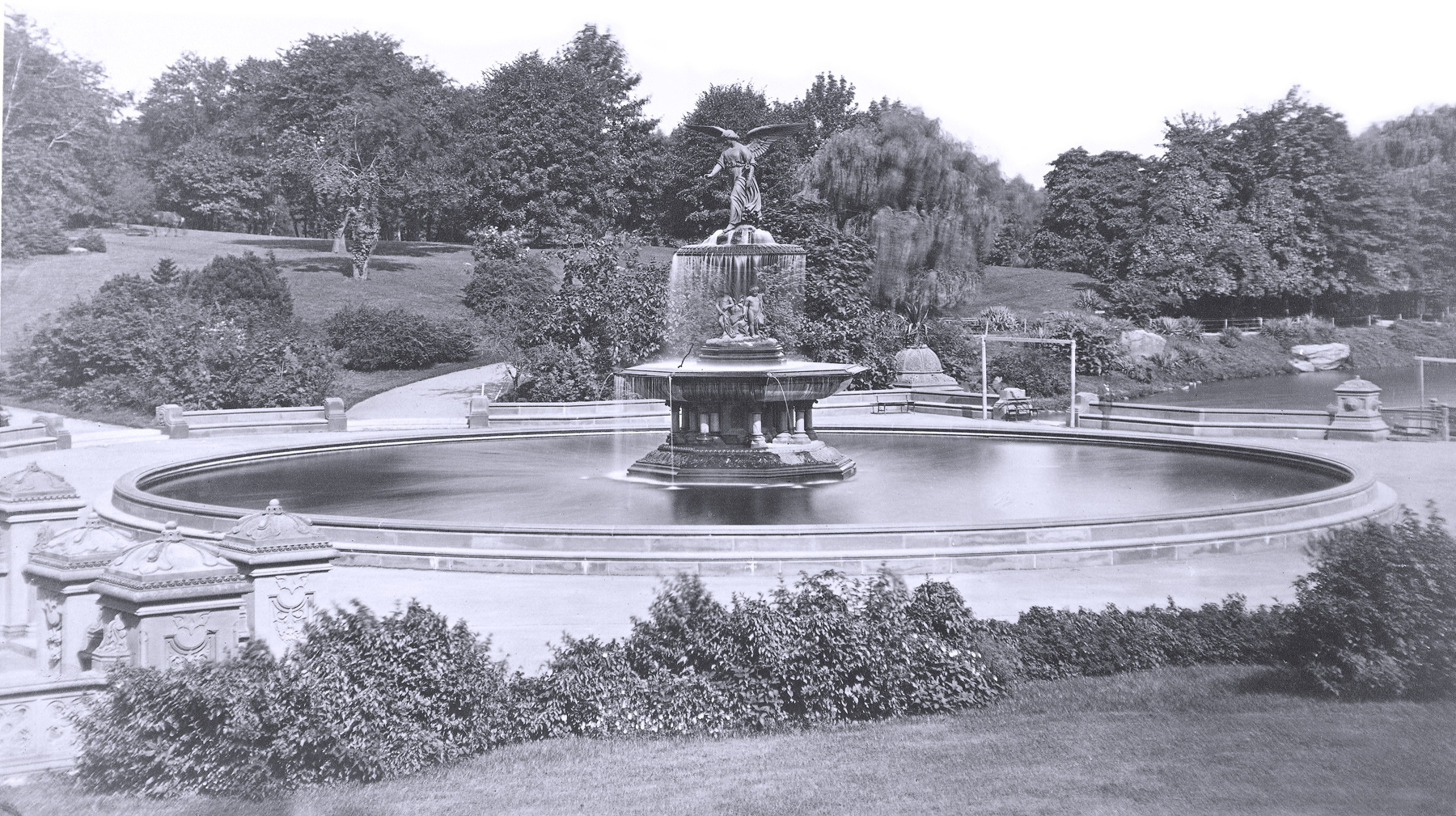
The Heart of Olmsted's Park
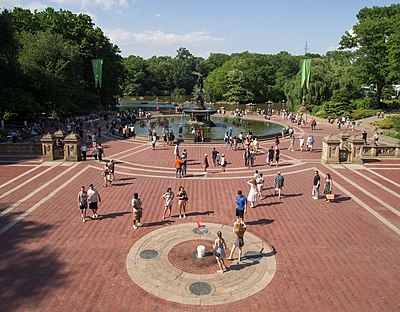
When Frederick Law Olmsted and Calvert Vaux won the competition to design Central Park in 1858, they conceived it as a democratic landscape — a pastoral countryside manufactured in the middle of the city, where all classes of New Yorkers could meet on equal ground. Bethesda Terrace is the one place where that naturalistic vision gives way to formal architecture: a grand two-level plaza at the end of the Mall, descending by twin staircases to the edge of the Lake. Vaux called it the heart of the park, and his collaborator Jacob Wrey Mould covered it with some of the most inventive carving in America — birds, fruit, and seasons cut into the sandstone, and a ceiling of gilded Minton tiles in the arcade below. By the 1880s, the era of the show, the Terrace was exactly what its designers intended: the place where fashionable carriages, promenading couples, and ordinary families all converged.
The Angel of the Waters
The fountain at the Terrace's center carries a distinction that resonates with the show's themes: it is the work of a woman. Emma Stebbins received the commission around 1861 — the first major public art commission awarded to a woman in New York City — and her bronze Angel of the Waters was unveiled in 1873. The angel commemorates the Croton Aqueduct, which had brought clean fresh water to a cholera-plagued city in 1842, and refers to the Gospel account of an angel troubling the healing waters of the pool of Bethesda. Four cherubs below represent Purity, Health, Peace, and Temperance. In an age when women could not vote and, in Agnes van Rhijn's world, could scarcely work, the most prominent sculpture in New York's great park was a woman's.
In HBO's The Gilded Age
Marian Brook and Peggy Scott walk at Bethesda Terrace in Season 1, and the location has returned across the series — one of the few settings filmed in the real place rather than a stand-in, since the Terrace survives essentially unchanged from the 1880s. The choice of setting does quiet work in the show: Central Park was designed as neutral ground, and it is precisely the kind of place where a well-born white woman and an ambitious Black writer could walk and talk as equals in public. The park also frames the show's geography — the van Rhijn and Russell houses face its southern edge, and a carriage drive in the park was an essential ritual of the society the series depicts.
Visiting the Fountain
Bethesda Terrace is mid-park at 72nd Street, an easy walk from either the Fifth Avenue or Central Park West entrances. Come early on a weekday morning and the scene is uncannily close to what Marian and Peggy would have seen: the angel over still water, the Ramble rising wooded beyond the Lake, and the carved staircases framing it all. The Minton-tiled arcade beneath the drive — restored and reopened in 2007 — is worth the detour on its own.
Fountain scenes filmed on location in the real Central Park. Address precisely known.
Books & Tours
Some links are affiliate links — we may earn a small commission at no cost to you.