Grand Central Depot (original)
42nd St & Park Ave
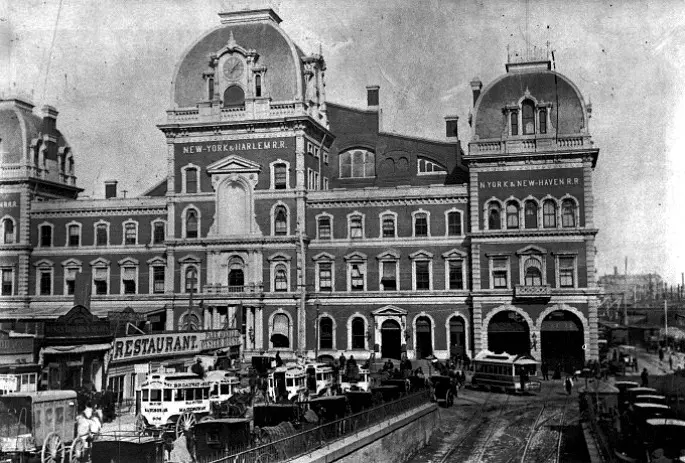
The Commodore's Monument
Cornelius "Commodore" Vanderbilt began as a Staten Island ferry boy and ended as the richest man in America, and the original Grand Central Depot of 1871 was the monument he built to his own empire. Having seized control of the New York Central, Hudson River, and Harlem railroads in a series of ruthless campaigns, he consolidated their Manhattan terminals into a single depot at 42nd Street — then the raw northern edge of the developed city. Behind the mansarded French Second Empire headhouse stretched the depot's true marvel: an arched iron-and-glass train shed a hundred feet high and six hundred feet long, the largest interior space on the continent, filled with steam and the traffic of a transportation empire. Critics mocked the site as too far uptown; Vanderbilt understood that the city would come to him, and it did.
In HBO's The Gilded Age
The Commodore is the primary real-world model for the show's George Russell — the self-made transport magnate whose railroad wars, stock maneuvers, and contempt for the men he outplays are drawn from Vanderbilt's career, with elements of Jay Gould and Collis Huntington mixed in. Russell's battles over lines, rates, and legislatures mirror the Commodore's actual consolidation of the New York roads, and the depot stands in the show's world as it did in the real one: the physical proof that new money could build something old New York had to use every single day, whether it approved of the builder or not. Vanderbilt died in 1877 leaving about $100 million — more than was held in the United States Treasury.
Depot, Station, Terminal
The 1871 depot was outgrown almost immediately. It was enlarged and rebuilt in the late 1890s as Grand Central Station, but the real reckoning came in 1902, when a fatal collision in the smoke-filled Park Avenue tunnel forced the railroad to abandon steam power in Manhattan. The answer was audacious: electrify everything, sink the tracks below grade, and build an entirely new Grand Central Terminal, completed in 1913. Burying the rail yards created Park Avenue itself — the air rights over the tracks became one of the most valuable real-estate corridors on earth, a second Vanderbilt fortune conjured out of empty space above the trains.
The Terminal Today
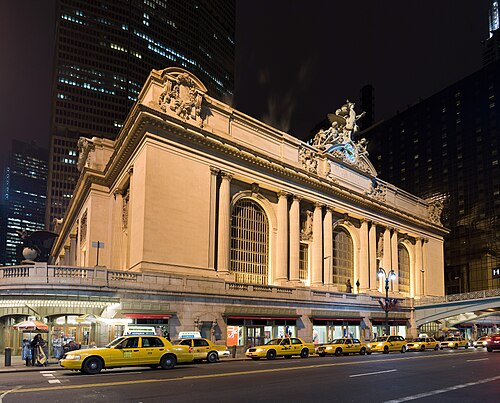
Grand Central Terminal remains one of the world's great railway spaces — the celestial ceiling, the four-faced opal clock, the whispering gallery — and it survives because New York learned the cost of losing its counterpart. The demolition of Penn Station in 1963 galvanized the landmarks movement, and when the terminal's owners sought to build a tower over it, a campaign famously championed by Jacqueline Kennedy Onassis carried the fight to the Supreme Court, which upheld New York's landmarks law in 1978. The Commodore's site, saved by his rivals' folly, now welcomes hundreds of thousands of people a day.
Exact historical site. Original 1871 Depot replaced by Grand Central Terminal in 1913.
Books & Tours
Some links are affiliate links — we may earn a small commission at no cost to you.