St. Thomas Episcopal Church
5th Ave & 53rd St
The Society Church of Fifth Avenue
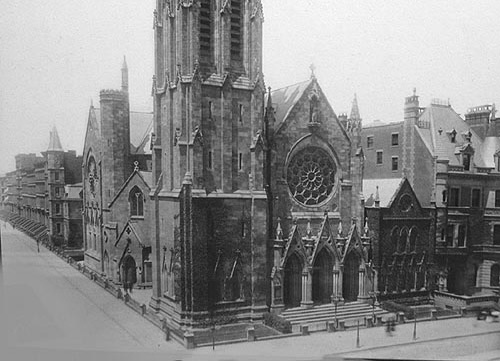
St. Thomas parish was founded in 1823 and spent its first decades downtown, but in 1870 it did what its wealthiest parishioners were doing: it moved up Fifth Avenue. The new church on the corner of 53rd Street, a brooding Gothic design by Richard Upjohn — the architect who defined American church-building at Trinity Church on Wall Street — placed the parish squarely in the path of society's northward march. Within a decade the Vanderbilt mansions rose just blocks away, and St. Thomas became the parish of the plutocracy. In the Gilded Age calendar, a fashionable wedding or funeral at St. Thomas was as much a social event as a religious one: the guest list was scrutinized, the floral bills were staggering, and the crowds outside on Fifth Avenue could number in the thousands.
The Wedding of the Century
No event fixed St. Thomas in history like the wedding of November 6, 1895, when eighteen-year-old Consuelo Vanderbilt married the ninth Duke of Marlborough. It was the supreme "dollar princess" match — an American railroad fortune traded for one of England's grandest titles — engineered almost entirely by the bride's mother, Alva Vanderbilt, over her daughter's private objections. Consuelo, who had wept that morning behind locked doors, arrived late; the crowds outside were so thick that police struggled to hold the avenue; and the settlement that followed transferred millions of Vanderbilt dollars to the upkeep of Blenheim Palace. The marriage was famously unhappy and eventually annulled, but it remains the defining image of the era's transatlantic title trade — the exact social bargain that HBO's series dramatizes.
In HBO's The Gilded Age
In the show's world, St. Thomas is the natural church of the van Rhijns and, increasingly, the Russells — the setting implied whenever society gathers in full finery for weddings, funerals, and Easter Sunday. The Easter parade scenes featuring the van Rhijn and Russell households were actually filmed at historic churches in Albany, whose intact nineteenth-century interiors stand in for what Fifth Avenue looked like before rebuilding. And the show's storyline of Gladys Russell's engineered marriage to an English duke is drawn directly from the Consuelo Vanderbilt story that played out beneath this church's roof — down to the ambitious mother, the reluctant bride, and the fortune crossing the Atlantic with her.
Fire and Rebirth
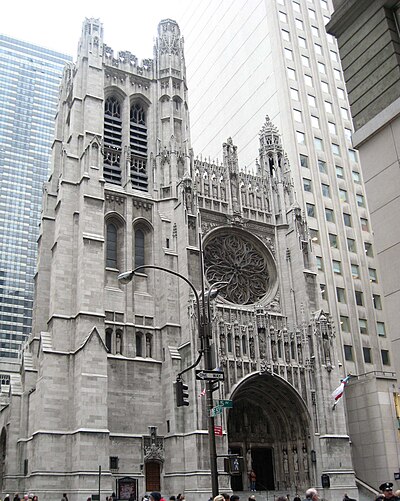
Upjohn's church burned in a spectacular fire in 1905, and the parish commissioned the firm of Cram, Goodhue & Ferguson to replace it. The result, opened in 1914, is one of the finest French High Gothic buildings in America: a limestone sanctuary whose vast carved reredos — an eighty-foot wall of saints and tracery behind the altar — is among the most breathtaking church interiors in New York. The building was designated a New York City landmark, and its choir of men and boys remains one of the most admired in the country. Unlike almost every other society address on this stretch of Fifth Avenue, St. Thomas never moved and was never demolished: it still holds its corner, a working parish surrounded by the towers of Midtown.
Church on this corner since 1870; second building burned 1905; present neo-Gothic structure opened 1914. Easter scenes filmed at Albany churches.