The New York Globe Office
Park Row / Newspaper Row, Lower Manhattan
Newspaper Row
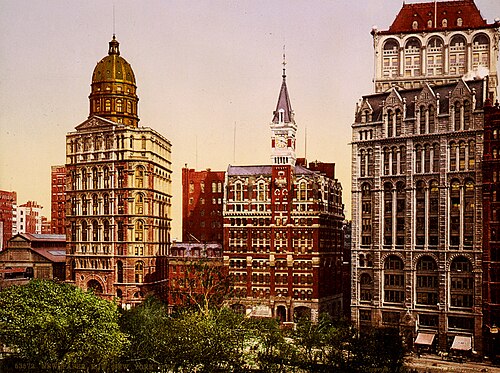
In the 1880s, virtually every newspaper that mattered in America was written within a few hundred yards of this spot. Park Row, the diagonal street facing City Hall Park, was "Newspaper Row": the Tribune under its tall clock tower, the Times in its marble palace, the Sun, the Herald's downtown operations, and soon Joseph Pulitzer's World beneath its gilded dome — at its 1890 completion the tallest building in New York. The concentration was practical. The papers fed on City Hall and the courts across the street, on the telegraph offices nearby, and on each other; reporters, compositors, and newsboys circulated among the buildings around the clock, and the presses in the basements shook the sidewalks every night. Alongside the giants operated dozens of smaller papers — trade sheets, foreign-language weeklies, and the Black press, including the paper where the show sends Peggy Scott.
T. Thomas Fortune and the Globe
Timothy Thomas Fortune, born enslaved in Florida in 1856, learned the printer's trade as a boy and arrived in New York to become the most influential Black journalist of his generation. The New York Globe, which he edited in the early 1880s, and its successors the Freeman and the New York Age, were the leading Black newspapers in the country — fearless in attacking segregation, lynching, and disenfranchisement at a moment when the retreat from Reconstruction made such editorials genuinely dangerous. Fortune argued for civil rights agitation decades before the NAACP existed, founding the Afro-American League in 1890 as one of the first national civil-rights organizations. He is one of the few characters in the show, alongside figures like Mrs. Astor and Ward McAllister, drawn directly from life under his real name.
Peggy in the Newsroom
Peggy Scott's job at the Globe places her at a double frontier. Journalism barely admitted women in the early 1880s — Nellie Bly's famous stunt reporting for the World was still years away — and the mainstream Row would not have hired a Black woman at all. The Black press was the exception: papers like Fortune's ran on talent they could not afford to turn away, and they published women writers and activists whom no other institution in the city would print. The show's newsroom scenes were filmed in the Carriage House at Lyndhurst, the Gould estate in Tarrytown whose outbuildings and interiors serve the production repeatedly — the same estate that stands in for Aurora Fane's house on this map.
Park Row Today
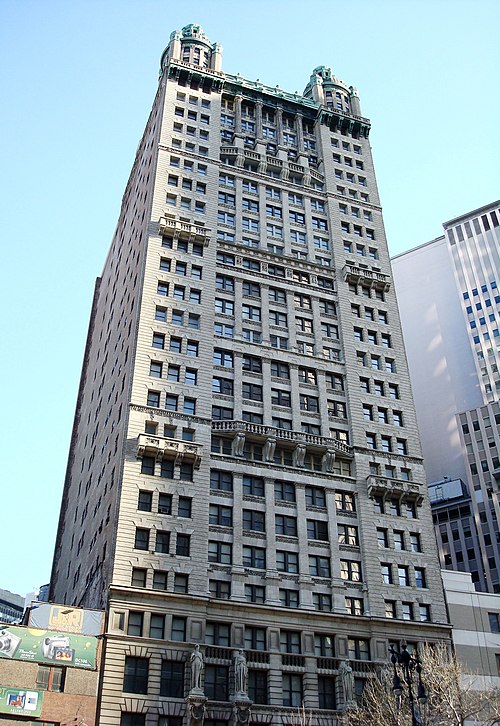
The Row's great buildings are mostly gone — the World and its dome fell in 1955 for a bridge approach — though the Park Row Building and a few neighbors survive, and the Potter Building's ornate terra-cotta still hints at the street's newspaper age. City Hall Park keeps the geography legible: stand at its east edge and every deadline sprint between a courtroom and a composing room happened within your view. This map's pin marks the district rather than a confirmed address for the Globe itself, which moved among the Row's modest offices.
T. Thomas Fortune's Globe operated in the Park Row Newspaper Row district in the early 1880s. Exact building unconfirmed. Lyndhurst's Carriage House used for filming interior.
Books & Tours
Some links are affiliate links — we may earn a small commission at no cost to you.